
Integrating a high-performance full rise scissor lift into an auto repair shop, tire service center, dealership workshop, or home garage structure represents a high-impact, strategic investment in vehicle maintenance efficiency, shop productivity, and technician safety. Professional automotive service across modern multi-bay facilities requires robust engineering capable of elevating passenger sedans, SUVs, electric vehicles, and light commercial trucks smoothly to ergonomic working heights. Installing an industrial-grade full rise scissor lift enables shop managers, service directors, and lead mechanics to eliminate underbody service bottlenecks, optimize shop bay footprint utilization, and drastically reduce physical strain associated with low-clearance vehicle inspection and repair methods.
Selecting an optimal full rise scissor lift requires a thorough, systematic evaluation of hydraulic drive mechanisms, platform spatial dimensions, maximum payload load ratings, foundation pit depth requirements, mechanical safety locks, and strict international safety code compliance standards. Modern auto lifting equipment options span from surface-mounted low-profile platforms up to heavy-duty flush-mount in-ground scissor lifts equipped with integrated wheel alignment turntables. Evaluating maximum lifting heights, structural concrete slab specifications, clear bay dimensions, and daily cycle frequencies ensures business owners invest in a fully customized vehicle lifting solution engineered specifically to maximize operational profitability, enhance shop throughput, and withstand relentless commercial workshop usage.
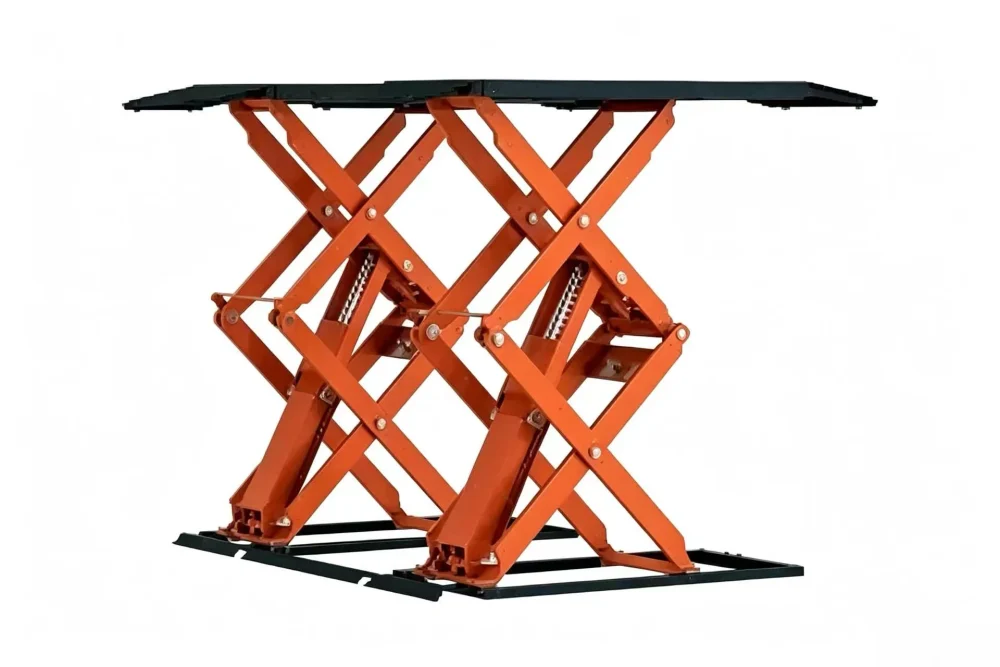
Technical Specifications and Architecture Comparison Matrix
Evaluate the comprehensive technical comparison matrix below to analyze baseline equipment cost ranges, structural foundation pit depth needs, electrical power requirements, maximum lifting height limits, and ideal application scenarios across primary workshop platform architectures:
| Lift Architecture | Baseline Equipment Cost (USD) | Pit Depth Requirement | Electrical Power Specs | Max Lifting Height | Optimal Application Scenario |
| Surface-Mounted Full Rise Scissor | $3,800 – $6,500 | 0″ Pit (Drive-on ramp) | 220V / 380V Single/3-Phase | Up to 75 Inches (1.9m) | Quick-service bays, tire service, chassis maintenance |
| Flush-Mount In-Ground Scissor | $4,500 – $8,500 | 12″ to 14″ Concrete Pit | 220V / 380V Single/3-Phase | Up to 78 Inches (2.0m) | Space-constrained shops, sleek luxury car showrooms |
| Wheel Alignment Scissor Lift | $6,200 – $11,500 | 0″ or 14″ Pit Option | 380V / 415V 3-Phase (15A) | Up to 85 Inches (2.15m) | Dedicated 4-wheel alignment bays, heavy chassis tuning |
| Heavy-Duty Commercial Scissor | $8,500 – $15,000 | 14″ to 18″ Standard Pit | 380V / 480V 3-Phase (20A) | Up to 78 Inches (2.0m) | Commercial fleet maintenance, heavy pickup trucks |
Exploring Core Drive Mechanisms for Workshop Vehicle Lifts
Understanding mechanical propulsion systems and hydraulic drive dynamics allows shop managers, auto technicians, architects, and business owners to select the precise full rise scissor lift configuration matching their bay layout and service workflow demands.
Electro-Hydraulic Dual-Cylinder Scissor Systems ($3,800 – $8,500)
Dual-cylinder hydraulic scissor platform lifts utilize twin hydraulic rams paired with synchronized fluid distribution systems to extend cross-pivoting heavy steel legs, hoisting the vehicle carriage smoothly to full standing working height.
Heavy Payload Capacity: Designed to support automotive weight ratings ranging routinely from 3,000 kg (6,600 lbs) up to over 5,500 kg (12,000 lbs) per lifting cycle.
Ergonomic Underbody Clearance: Delivers unobstructed open-center or wide-runway under-car access, allowing technicians to perform exhaust replacement, transmission swaps, and brake servicing with full overhead headroom.
Space-Saving Footprint: Eliminates side structural posts found on traditional 2-post and 4-post lifts, preserving critical drive-through bay clearance in narrow service garages.
In-Ground Flush-Mount Scissor Assemblies ($4,500 – $9,500)
Flush-mounted in-ground scissor platform lifts integrate directly into pre-excavated concrete floor recesses, resting flush with surrounding workshop floor slabs when fully lowered.
Zero Obstruction Drive-Over: Ideal for low-ground-clearance sports cars, lowered vehicles, and busy multi-bay workshops requiring clear cross-shop vehicle drive-through paths.
Clean Architectural Aesthetic: Maintains an ultra-clean, modern workshop environment suitable for luxury dealership display bays and high-end detailing studios.
Precision Wheel Alignment Scissor Lifts ($6,200 – $11,500)
Alignment-spec scissor lifts feature precision-machined platform runways equipped with front turntable recesses, rear slip plates, and secondary jack-beam lifting platforms.
Integrated Wheel Alignment Recesses: Engineered specifically for 3D laser wheel alignment equipment, ensuring absolute leveling accuracy across long wheelbases.
Secondary Wheel-Free Lifting: Integrated auxiliary scissor jacks raise vehicle wheels off the main runway for simultaneous tire replacement and suspension inspections.
Critical Structural Engineering & Site Preparation Factors
Successfully installing a durable full rise scissor lift requires evaluating key site infrastructure requirements prior to factory equipment fabrication and site delivery.
Surface Mounting vs. Flush-Mount Pit Excavation
Flush Floor Pit Installation: Excavating a shallow concrete pit (typically 12 to 14 inches deep) allows the platform steel assembly to rest completely flush with surrounding finished floor surfaces. This enables sports cars and low-slung vehicles to enter the bay without bottoming out on ramps.
Surface Mounting with Ramps: Where floor slab cutting or concrete pit excavation is prohibited by structural post-tension slab designs or leased building terms, mounting the lift directly onto existing concrete floors accompanied by low-profile drive-on steel ramps avoids foundation modification costs completely.
Concrete Foundation Slab & Anchor Requirements
Commercial vehicle lifts require minimum concrete slab specs (typically 6 inches or 150mm thick with 3,000 PSI reinforced concrete) to ensure solid anchor bolt retention and structural rigidity under full load.
Power Infrastructure & Hydraulic Control Consoles
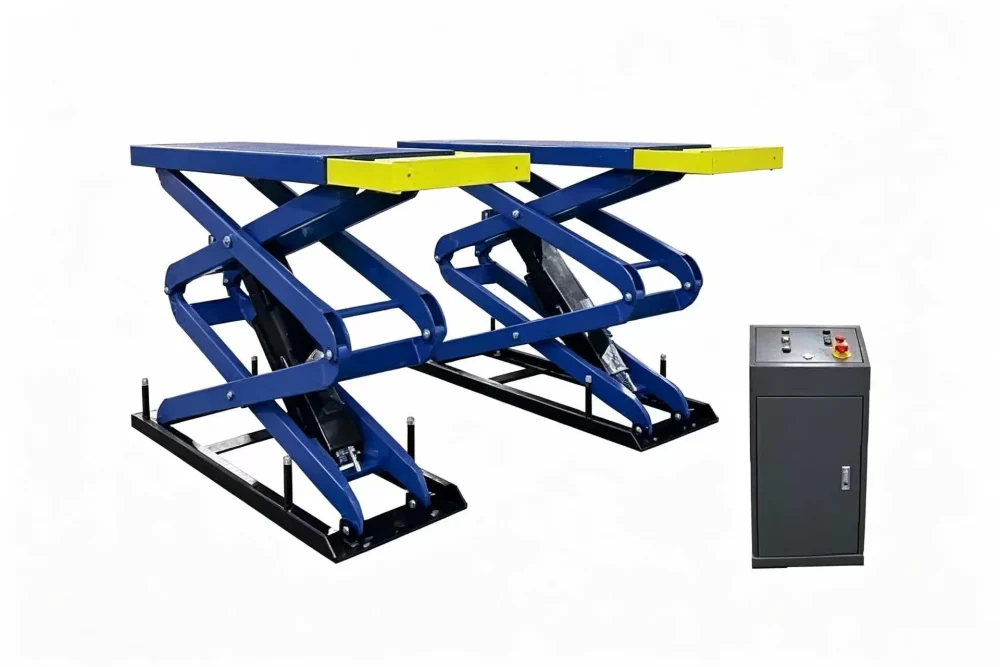
Standard commercial auto lifts require dedicated single-phase or three-phase electrical power (220V, 380V, or 480V at 50/60 Hz). Standalone control consoles house high-pressure hydraulic pumping units, PLC control boards, pneumatic safety release valves, and digital elevation push-button switches.
Industrial Safety Features & Code Compliance
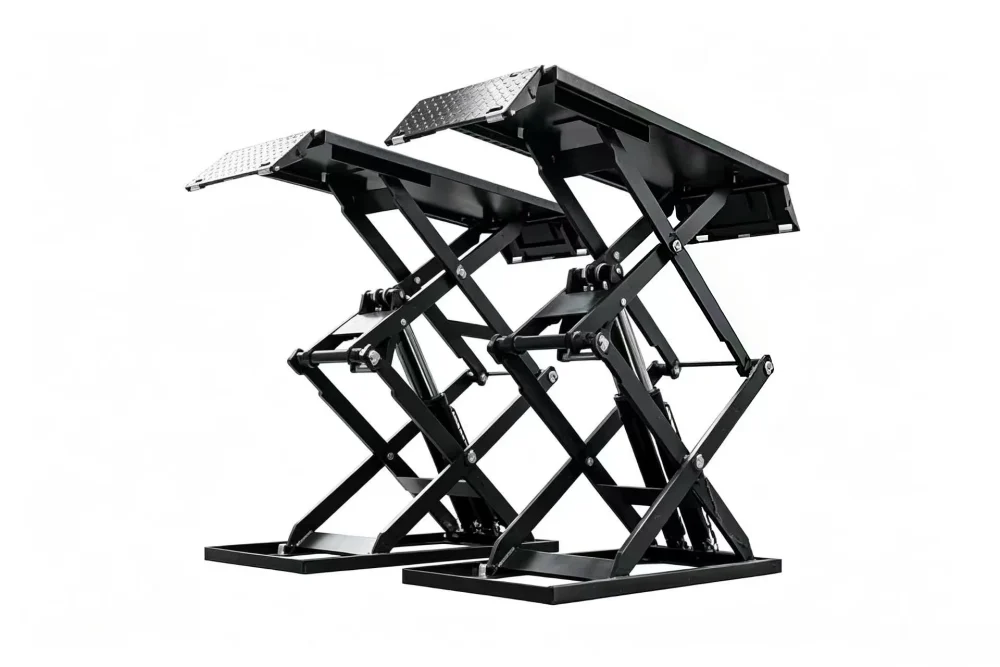
Equipping a full rise scissor lift with multi-tiered redundant safety systems protects shop personnel, prevents vehicle damage, and maintains compliance with global machinery safety standards (such as CE directives or ALI certification requirements).
Pneumatic Multi-Position Safety Locks: Heavy-duty mechanical safety ratchets engage automatically across multi-stage height positions, locking the platform securely on mechanical steel stops.
Hydraulic Synchronization & Velocity Valves: Hydraulic flow-equalization valves ensure both platform runways ascend and descend perfectly parallel, while velocity fuses prevent rapid platform descent in the event of a hose failure.
Lowering Warning Alarm & Foot Guard Clearance: Automatic audible buzzers signal platform lowering during the final 12 inches of descent to protect technician feet from pinch hazards.
Emergency Stop Switches and Limit Switches: Prominent emergency stop buttons installed on the main control console allow immediate operation shutdown, while top height limit switches prevent cylinder over-extension.
24V Low-Voltage Control System: All operator push-buttons and safety switches utilize safe 24V DC circuit power to eliminate electrical shock risks in damp service bay environments.
Step-by-Step Full Rise Scissor Lift Procurement Checklist
Following a systematic checklist ensures your full rise scissor lift procurement matches project timelines, engineering specifications, and daily workshop service volume requirements:
1. Calculate Maximum Vehicle Weight and Wheelbase Dimensions
Measure peak vehicle gross weights, wheelbase lengths, and chassis pickup point dimensions across target customer vehicles (from compact cars to heavy EV SUVs and light commercial vans).
2. Verify Available Overhead Clearance and Bay Footprint
Measure available ceiling clearance heights within the service bay to ensure sufficient total head room for vehicles raised to full standing elevation (minimum 11-foot ceiling height recommended).
3. Establish Site Electrical and Compressed Air Specifications
Confirm standard power availability (220V or 380V) and shop compressed air supply (6-8 bar required for pneumatic safety lock disengagement) at the designated installation bay.
4. Review Local Workshop Building Codes and Permitting Needs
Verify municipal workshop safety permits and garage equipment registration requirements with local safety authorities prior to finalizing equipment layout drawings.
5. Select Warranty Coverage and After-Sales Support Contracts
Partner directly with established manufacturers offering multi-year structural steel warranties (5+ years), ready availability of replacement spare parts, and dedicated technical support.
Long-Term Full Rise Scissor Lift Maintenance & Optimization
Establishing a proactive maintenance program ensures peak operational efficiency, minimizes unplanned bay downtime, and extends equipment lifespans across demanding commercial repair shop environments.
Scheduled Maintenance Protocol and Inspection Timelines
Monthly Inspection Routine: Inspect mechanical safety lock latches, pneumatic release lines, hydraulic hose fittings, oil reservoir levels, and platform equalizer cables or synchronization valves for wear or leaks.
Quarterly Fluid & Structural Analysis: Test hydraulic oil viscosity and cleanliness to protect pump control valves and cylinder seals from premature abrasive wear. Grease all scissor leg pivot pins and hinge points.
Annual Safety Load Tests: Perform full-capacity load elevation tests and mechanical lock engagement checks to verify structural safety mechanisms function under maximum rated payload conditions.
Replacement Part Availability and Technical Support
Working directly with an established factory manufacturer guarantees immediate access to critical replacement parts. Stocking essential spare components locally—including replacement control switches, hydraulic solenoid valves, limit switches, pneumatic lock cylinders, and seal kits—ensures fast resolution during routine maintenance or unforeseen operational halts.
Comprehensive Project Investment Budgeting Overview
When planning a workshop facility upgrade, shop owners should account for the complete turnkey investment involved in acquiring a high-performance full rise scissor lift:
Core Factory Equipment: $3,800 – $15,000 depending on platform capacity, alignment specs, flush-mount design, and drive configuration.
International Freight & Logistics: Shipping, container loading, and customs clearance depending on destination port.
Civil Site Preparation: $500 – $2,500 for concrete pit excavation, slab cutting, or foundation pad pouring.
Electrical & Air Line Wiring: $300 – $1,000 for dedicated electrical drops, circuit breakers, and air supply connections.
Professional Mechanical Installation: $800 – $2,500 for local mechanical anchoring, hydraulic fluid filling, synchronization tuning, and safety testing.
Accounting for these budgeting factors upfront provides clear capital expenditure visibility and ensures a seamless project execution timeline.
Frequently Asked Questions (FAQ)
Q1: Is a full rise scissor lift better than a 2-post lift for home garages?
Yes. A full rise scissor lift offers a much lower visual footprint when lowered, preserves side drive-through space, and requires less bay width than a 2-post lift. However, ceiling height must still accommodate full vehicle elevation.
Q2: What is the typical lead time for custom scissor lift manufacturing?
Factory engineering design and custom fabrication generally require 15 to 25 business days, depending on platform length customizations, wheel alignment specifications, and power unit voltage configurations.
Q3: Is a concrete pit required to install a full rise scissor lift?
No. Surface-mounted models sit directly on existing concrete floors and utilize low-profile drive-on ramps. Flush-mount models, however, require a pre-cut 12-to-14-inch concrete pit for flush floor resting.
Q4: Can a full rise scissor lift be used for 4-wheel alignments?
Yes. Dedicated wheel alignment scissor lifts feature integrated turntable recesses, rear slip plates, and auxiliary jack beams engineered specifically for precision 3D wheel alignment equipment.
Q5: How often should hydraulic fluid be replaced in a workshop lift?
Under normal single-shift commercial garage operating conditions, hydraulic fluid should be refreshed every 12 to 18 months to ensure optimum valve actuation, smooth lifting travel, and extended pump life.
Q6: What is the maximum lifting capacity for commercial scissor lifts?
Standard passenger vehicle scissor lifts support 3,500 kg to 4,500 kg (7,700 lbs to 10,000 lbs), while heavy-duty commercial truck models can be engineered to lift up to 6,000 kg (13,200 lbs) or more.
Upgrade Your Service Workshop Today
Investing in a high-performance full rise scissor lift restores workshop operational efficiency, eliminates service bay bottlenecks, improves technician ergonomics, and maximizes multi-bay facility space utilization.
For custom engineering CAD dimensional drawings, structural foundation specifications, site assessment assistance, or direct factory pricing on a tailored full rise scissor lift, contact our technical specialists today:
Email: [email protected]
Phone / WhatsApp: +86 189 5417 1380
 Spanish
 English
 Arabic
 French
 Korean
 German
 Russian