
Equipping a commercial auto repair facility or high-volume service bay with the right automotive lifting equipment is one of the most critical operational investments a shop owner can make. An auto shop car lift serves as the backbone of everyday garage operations, directly impacting mechanic productivity, vehicle turnaround speed, technician safety, and overall workshop profitability.
Whether you are expanding a multi-bay dealership service center, opening an independent auto repair business, or upgrading existing lifting equipment to handle modern electric vehicles (EVs) and heavy-duty trucks, selecting the ideal vehicle lift requires evaluating hydraulic technology, weight capacity, structural safety certification, and shop ceiling height limits.
In this comprehensive technical guide, we evaluate the primary types of vehicle lifts used in modern automotive repair shops, compare essential engineering specifications, break down installation and site preparation requirements, outline ALI safety standards, and provide key buyer insights.
Primary Types of Commercial Auto Shop Car Lifts
Different repair tasks—ranging from quick tire rotations and brake service to complex transmission replacements and wheel alignments—demand specific vehicle lift configurations. Choosing the appropriate design depends on your service specialty and shop space constraints.
1. Two-Post Car Lift (Clear-Floor & Floor-Plate)
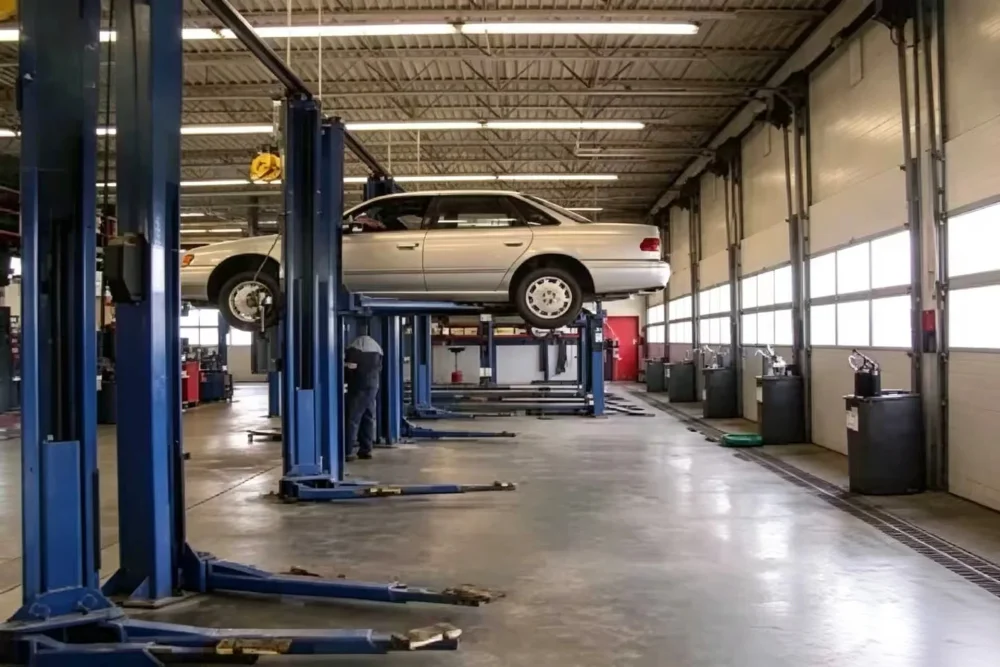
The two-post auto shop car lift is the undisputed workhorse of the automotive service industry. By engaging the vehicle’s frame at four designated lifting points using adjustable swing arms, a two-post system leaves the wheels hanging freely and the undercarriage completely exposed.
Clear-Floor Design: Hydraulic lines and cables run overhead through a top crossbeam, leaving the concrete floor unobstructed for rolling toolboxes and transmission jacks.
Floor-Plate Design: Hydraulic hoses run across the floor under a low-profile steel threshold plate, ideal for shops with lower ceiling clearances.
Best For: General mechanical repair, brake work, suspension overhaul, exhaust replacement, and engine service.
2. Four-Post Vehicle Lifts
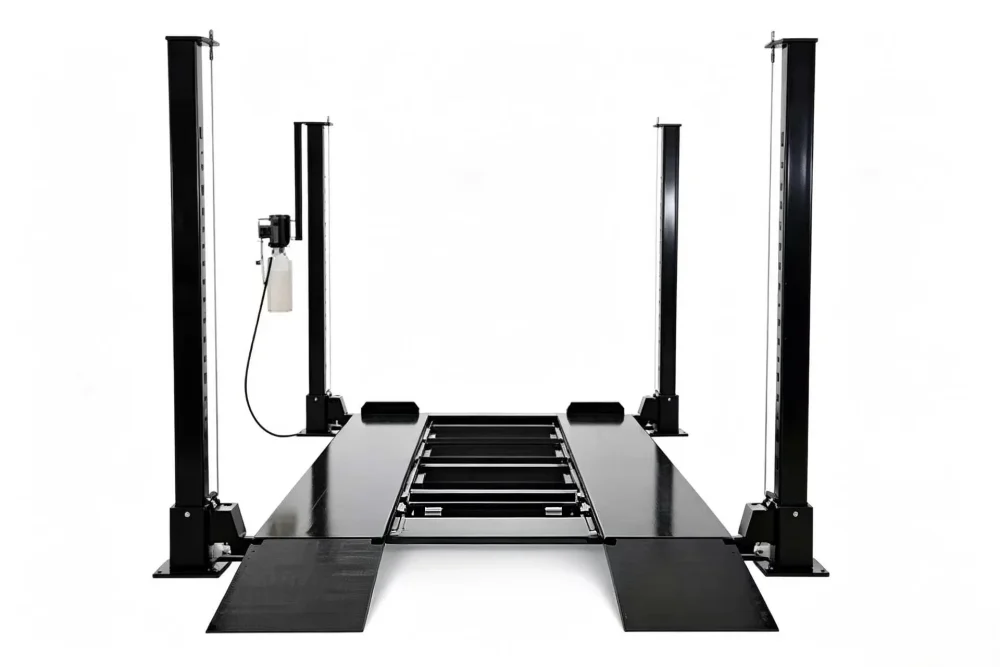
Four-post automotive lifts utilize two solid drive-on steel runways supported by four vertical structural columns. The vehicle is simply driven directly onto the tracks, eliminating the time needed to position swing arms under frame lifting points.
Integrated Rolling Jacks: Many four-post units feature pneumatic or hydraulic rolling bridge jacks that slide along inner runway rails to lift wheels off the tracks for brake and wheel service.
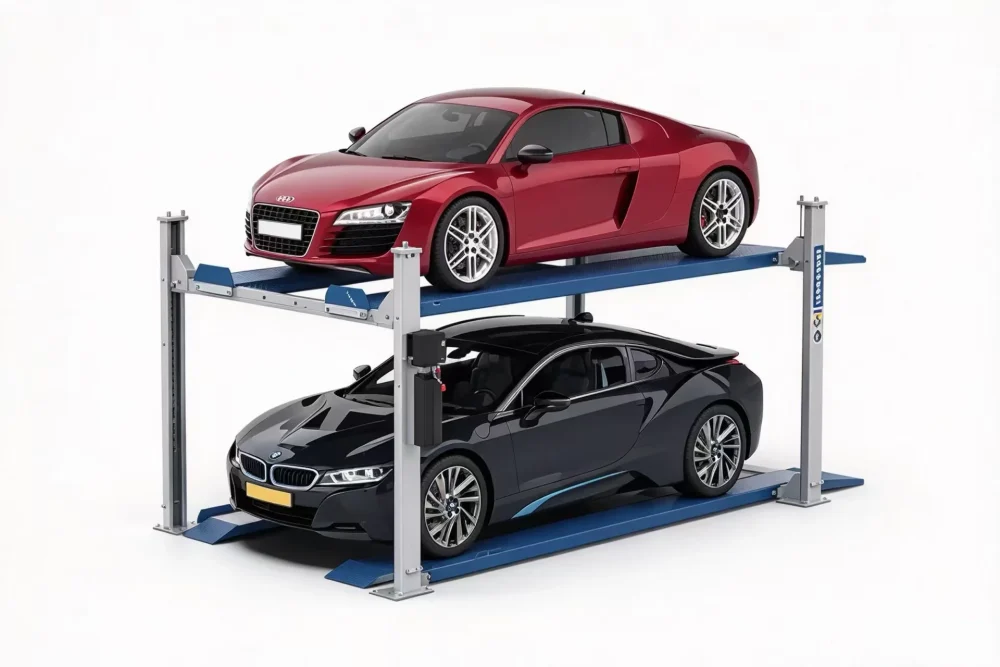
Best For: Commercial wheel alignment systems, heavy-duty truck maintenance, high-density vehicle storage, and fast drive-in oil inspection bays.
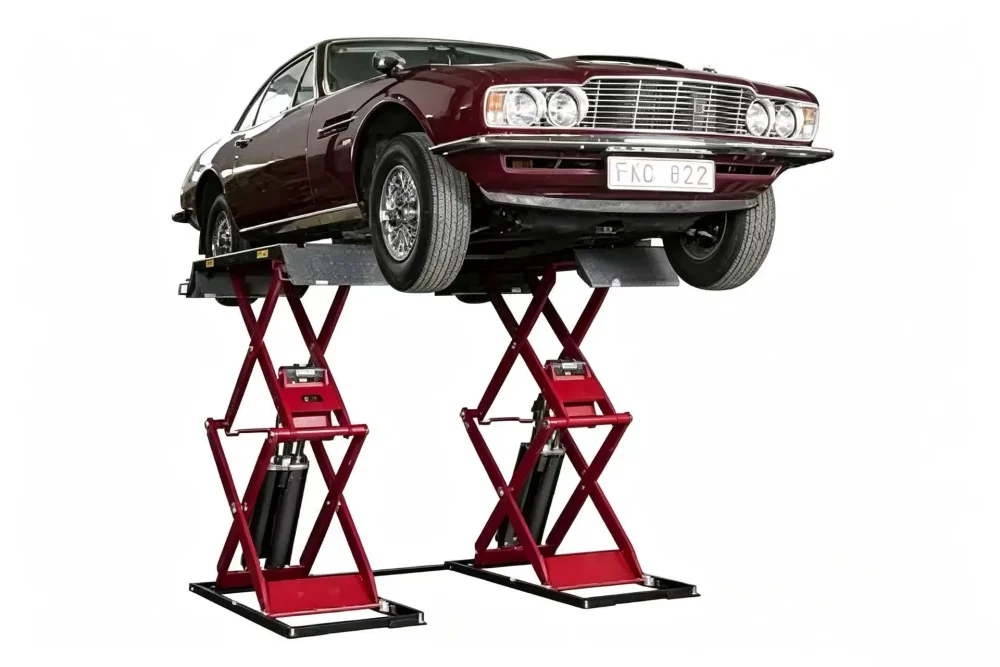
3. Mid-Rise & Full-Rise Scissor Lifts
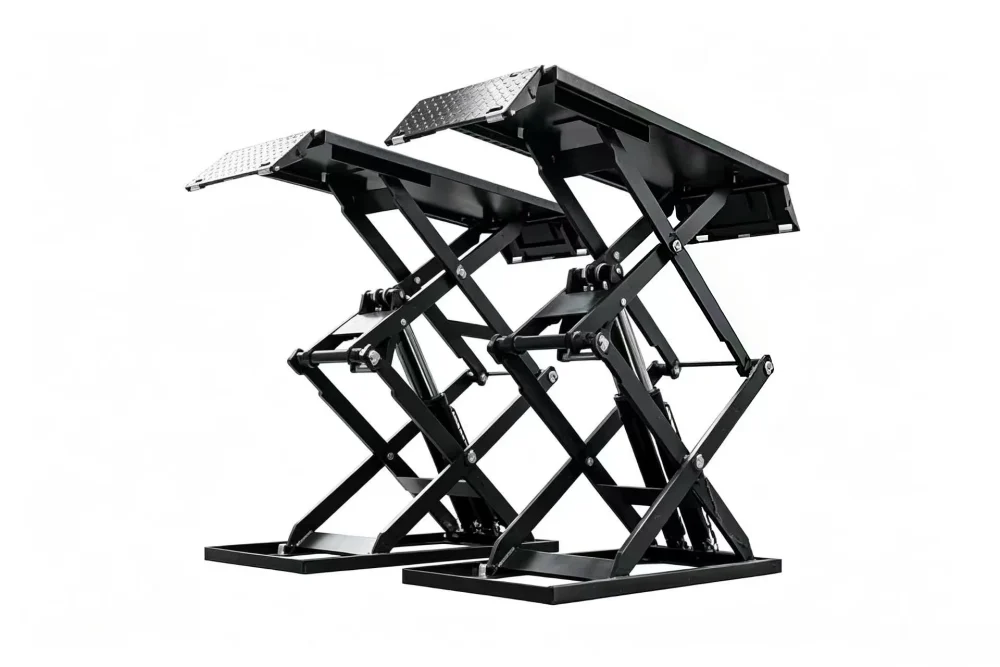
Scissor lifts utilize pantograph lifting mechanisms positioned beneath the platform to raise vehicles vertically without requiring outer vertical columns.
In-Ground & Surface-Mounted: Flush-mount in-ground scissor lifts fold flat into concrete floor recesses, leaving the shop floor completely clear when not in use.
Best For: Fast-lube service bays, tire shops, body paint shops, detailing centers, and tight space layouts where vertical columns would obstruct technician movement.
Technical Specifications & Equipment Comparison Matrix
To assist shop owners, service managers, and facility architects in selecting the correct lifting equipment, the matrix below compares core engineering parameters across different vehicle lift configurations:
| Technical Feature | 2-Post Car Lift | 4-Post Alignment Lift | Mid-Rise Scissor Lift | Heavy-Duty 2-Post Lift |
| Typical Payload Capacity | 9,000 lbs – 10,000 lbs (4.5 Tons) | 12,000 lbs – 18,000 lbs (5.5–8 Tons) | 6,000 lbs – 10,000 lbs (3–4.5 Tons) | 12,000 lbs – 15,000 lbs (5.5–7 Tons) |
| Lifting Height Range | 72 in – 78 in (1.8 m – 2.0 m) | 70 in – 78 in (1.8 m – 2.0 m) | 36 in – 48 in (0.9 m – 1.2 m) | 72 in – 80 in (1.8 m – 2.0 m) |
| Minimum Overhead Ceiling Height | 12 ft – 14 ft (3.6 m – 4.2 m) | 10 ft – 12 ft (3.0 m – 3.6 m) | 8 ft – 10 ft (2.4 m – 3.0 m) | 13 ft. 6 in – 15 ft (4.1 m – 4.6 m) |
| Lifting Time (Full Rise) | 45 – 55 seconds | 50 – 60 seconds | 30 – 45 seconds | 50 – 60 seconds |
| Drive System Mechanism | Dual Direct-Drive Hydraulic Rams | Single Hydraulic Cylinder & Steel Cables | Dual Hydraulic Cylinders & Scissor Arms | Heavy-Duty Hydraulic Rams & Chains |
| Power Requirements | Single-Phase 220V / 30A | Single-Phase 220V or 3-Phase 380V | Single-Phase 220V / 20A | Single-Phase 220V or 3-Phase |
Key Factors to Consider When Buying an Auto Shop Car Lift
Selecting the right commercial lifting system involves analyzing vehicle weight distribution, shop dimensions, power availability, and safety certification.
1. Payload Capacity and Vehicle Fleet Diversity
Ensure the lift capacity matches the heaviest vehicles your repair shop services regularly:
9,000 lbs to 10,000 lbs Capacity: Standard capacity for passenger sedans, compact crossovers, and light SUVs.
12,000 lbs to 15,000 lbs Capacity: Essential for servicing full-size work trucks (Ford F-250/F-350, Chevrolet Silverado 2500/3500), commercial delivery vans, and heavy battery electric vehicles (EVs).
2. Shop Ceiling Height and Concrete Slab Thickness
Before purchasing a heavy-duty auto shop car lift, accurate site measurement is mandatory:
Ceiling Height: A standard two-post clear-floor lift requires a minimum ceiling height of 12 to 14 feet to ensure raised vehicles do not contact overhead lighting, HVAC ducting, or roof trusses.
Concrete Foundation: Two-post surface-mounted lifts require a level concrete slab with a minimum thickness of 4 to 6 inches and a compressive rating of at least 3,000 PSI to anchor heavy-duty wedge anchor bolts securely.
3. Electric Vehicle (EV) Service Readiness
As electric vehicles gain market share, service bays must adapt. EVs feature heavy underbody lithium-ion battery packs that alter weight distribution and require specialized wide-reaching asymmetric or symmetric lifting arms with low-profile pad adapters to avoid damaging sensitive chassis battery trays.
Safety Standards and ALI Certification
Safety is paramount in any commercial vehicle repair environment. Operating an uncertified or under-rated auto shop car lift creates severe hazards for technicians and risks catastrophic equipment failure.
1. ALI Certification (Automotive Lift Institute)
When sourcing a commercial vehicle lift, verify that the equipment carries official ALI Certification (ANSI/ALI ALCTV). ALI-certified lifts undergo rigorous independent testing to ensure structural integrity, mechanical safety lock performance, and rated load capacity compliance.
2. Mechanical Safety Lock Systems
High-quality commercial lifts incorporate automatic multi-position mechanical safety locks along vertical columns. As the lift ascends, spring-loaded steel latches engage every few inches. Once at working height, the hydraulic pressure is lowered onto these mechanical locks, securing the load without relying solely on hydraulic line pressure.
3. Overhead Safety Shut-Off Bars
On two-post clear-floor models, a padded overhead shut-off bar spans the top crossbeam. If a tall vehicle or roof rack touches the bar during ascent, a limit switch immediately disconnects electrical power to the hydraulic pump, preventing vehicle roof damage.
Installation, Maintenance, and Operating Costs
Maximizing equipment lifespan and operational safety requires proper installation and routine preventive maintenance.
1. Equipment and Installation Budgeting
Base Equipment Cost: Quality commercial two-post and four-post lifts range from $2,500 to $8,500, depending on weight capacity, lifting height, and brand certification. Heavy-duty in-ground or alignment scissor systems can cost $10,000 to $25,000+.
Professional Installation: Hiring certified lift installers ensures precise column plumbing, correct concrete anchor torque, and hydraulic bleed procedures, typically costing $800 to $2,000 per lift.
2. Routine Preventive Maintenance Checklist
Daily: Check automatic arm restraints, inspect hydraulic hoses for leaks, and test mechanical safety lock engagement.
Monthly: Inspect steel equalizer cables for fraying, check hydraulic fluid levels, and grease column glide blocks and arm pins.
Annually: Perform a comprehensive ALI safety inspection, check anchor bolt torque, and inspect hydraulic cylinder seals.
Frequently Asked Questions (FAQ)
Q1: What is the difference between asymmetric and symmetric two-post lifts?
Symmetric lifts feature equal-length swing arms that position the vehicle centered between the columns, ideal for heavy trucks. Asymmetric lifts feature angled columns and unequal-length arms that angle the vehicle slightly rearward, allowing technicians to open vehicle doors wider for easy cabin access.
Q2: What type of auto shop car lift is best for wheel alignments?
A four-post alignment lift equipped with integrated rear slip plates and front turn-plate recesses is the industry standard for precision four-wheel alignment systems.
Q3: How deep must concrete be to install a 10,000 lb two-post car lift?
A 10,000 lb two-post auto shop car lift typically requires a concrete floor slab with a minimum thickness of 4 inches (100 mm) rated at 3,000 PSI or greater. Heavier 12,000 lb to 15,000 lb lifts require 6 inches (150 mm) of reinforced concrete.
Q4: Can a two-post car lift be installed outdoors?
While possible, installing a standard lift outdoors exposes electrical motors and hydraulic valves to moisture, leading to rust and short circuits. If outdoor operation is required, select weather-protected models with IP65 electrical enclosures and galvanized structural steel finishes.
Q5: How long does a commercial garage lift typically last?
With proper daily operation, routine lubrication, and annual safety inspections, a high-quality commercial vehicle lift easily lasts 10 to 15+ years in a high-volume service shop.
Request a Custom Factory-Direct Quote
Choosing the ideal automotive shop lift is one of the most critical decisions for any repair facility—it directly boosts overall workshop productivity while providing an uncompromising safety net for your technicians. Whether you are outfitting a high-volume, multi-bay commercial service center or strategically expanding your growing automotive repair business, partnering directly with an experienced equipment manufacturer is a smart investment. Doing so ensures you receive reliable, heavy-duty performance, gain access to dedicated technical support, and secure highly competitive factory-direct pricing to maximize your return on investment.
For technical CAD drawings, structural column loading specs, or direct factory quotes on high-performance automotive lifts, contact our sales engineering team today:
Phone / WhatsApp: +86 189 5417 1380
Email: [email protected]
 French
 English
 Arabic
 Korean
 Spanish
 German
 Russian