
Choosing the right automotive lifting equipment is one of the most critical decisions for professional mechanics, commercial auto repair shops, and home garage enthusiasts alike. Whether your primary goal is performing complex suspension overhauls, routine oil changes, or doubling your vehicle parking capacity in a residential garage, evaluating a 2 post vs 4 post car lift is the necessary first step. Both lift designs offer exceptional hydraulic power and safety, yet they differ fundamentally in structural footprint, drive-on convenience, vehicle accessibility, and site installation prerequisites.
Selecting the wrong lifting solution can lead to operational bottlenecks, unsafe working conditions, or costly garage modifications. In this comprehensive technical guide, we break down everything you need to know when assessing a 2 post vs 4 post car lift, comparing their core mechanical mechanisms, weight capacity capabilities, garage space requirements, maintenance workflows, and total cost of ownership.
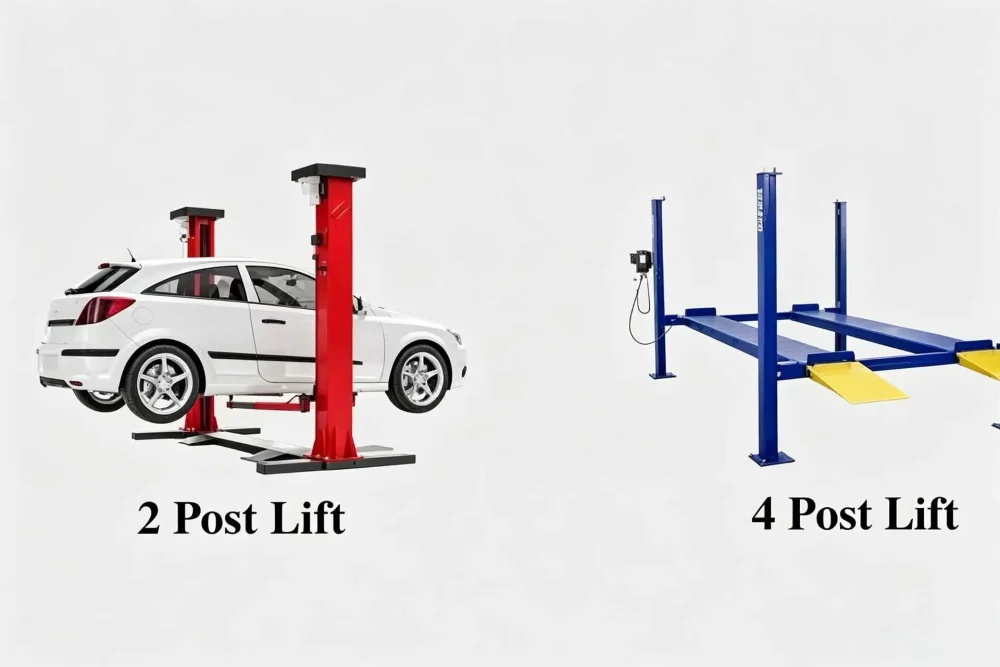
Understanding the Structural Differences
To make an informed purchasing decision when analyzing a 2 post vs 4 post car lift, you must first understand how each machine engages and supports a vehicle.
What is a 2 Post Car Lift?
A 2 post lift—a core option in the 2 post vs 4 post car lift debate—consists of two heavy-duty steel columns anchored directly to your concrete floor, connected overhead or across the floor by a hydraulic hose crossmember. Four adjustable swing arms extend from lifting carriages mounted inside the columns. These swing arms swing under the vehicle’s chassis to contact frame lifting points, leaving all four wheels dangling completely free in the air.
Frame-Engaging Operation: Because the vehicle rests entirely on its structural frame or pinch welds, the wheels, suspension assemblies, brakes, and undercarriage components are completely accessible.
Minimal Footprint: A 2 post lift occupies significantly less garage floor area, making it ideal for tight service bays where floor space is at a premium.
What is a 4 Post Car Lift?
In any 2 post vs 4 post car lift comparison, a 4 post lift features four vertical steel posts supporting two parallel steel drive-on runways or ramps. To use a 4 post lift, you simply drive the vehicle straight up the ramps and park it on the runways. The lift engages the tires rather than the frame, keeping the vehicle’s suspension naturally loaded at ride height.
Wheel-Engaging Operation: Driving onto the runways requires minimal setup time, as there is no need to manually position swing arms or locate precise chassis lift points.
Vehicular Storage Solution: Because the wheels rest securely on wide runways, a 4 post lift is inherently stable and excels at long-term double-stack parking storage in residential garages.
2 Post vs 4 Post Car Lift: Detailed Head-to-Head Comparison
To help architects, shop owners, and automotive hobbyists quickly evaluate technical trade-offs, the comparison matrix below breaks down key operational parameters when reviewing a 2 post vs 4 post car lift:
| Specification / Feature | 2 Post Car Lift | 4 Post Car Lift |
| Primary Lift Mechanism | Frame-engaging (Swing Arms) | Wheel-engaging (Drive-on Runways) |
| Wheel & Suspension Access | Complete, unrestricted access | Requires secondary rolling jack bridges |
| Typical Weight Capacity | 9,000 lbs to 18,000 lbs | 9,000 lbs to 40,000+ lbs |
| Garage Floor Footprint | Compact (approx. 11–12 ft wide) | Larger (approx. 10–12 ft wide x 18–22 ft long) |
| Concrete Floor Requirements | Strict: 4″–6″+ thick, 3000 PSI concrete | Flexible: Can often rest unanchored on flat slab |
| Ceiling Height Needed | High: Typically 11 ft to 14+ ft | Variable: 9 ft to 12+ ft (depends on vehicle height) |
| Storage Capability | Not recommended for long-term storage | Excellent for double-stacking vehicles |
| Drive-On Convenience | Requires positioning arms & lifting pads | Drive straight on; zero arm positioning |
| Power Requirements | 220V single-phase / 20–30A standard | 110V or 220V single-phase available |
Work Accessibility and Service Capabilities
Evaluating workflow requirements is paramount when weighing a 2 post vs 4 post car lift for commercial service bays or personal workshops.
Undercarriage Serviceability
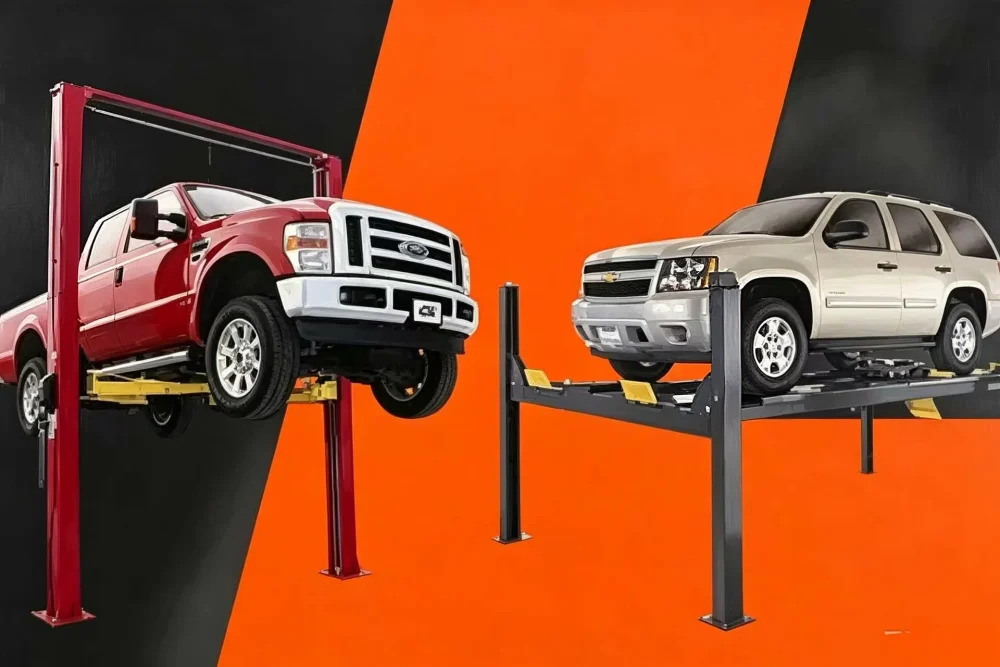
When evaluating a 2 post vs 4 post car lift for major repairs, if your daily work involves transmission removals, exhaust system replacements, differential swaps, or full brake jobs, a 2 post lift is the industry gold standard. Because there are no runways blocking the center or sides of the chassis, mechanics enjoy unobstructed 360-degree access to underbody components.
Drive-On Speed and Wheel Alignment
Conversely, when evaluating a 2 post vs 4 post car lift for quick-service bays, oil change lanes, or wheel alignment stations, 4 post models hold a distinct advantage. Driving directly onto the tracks eliminates arm positioning time, drastically increasing bay turnaround speed. Furthermore, adding turntables and slip plates transforms a 4 post unit into a dedicated wheel alignment rack.
Garage Space, Ceiling Height, and Concrete Requirements
Site preparation is a crucial factor when deciding between a 2 post vs 4 post car lift. Installing a lift safely depends heavily on your building’s structural foundation and vertical clearance.
Concrete Slab Thickness and PSI Anchoring
Examining structural loads in a 2 post vs 4 post car lift reveals that a 2 post lift exerts immense leverage and pulling force on its foundation because the entire vehicle weight is cantilevered from two columns. Consequently, most manufacturers mandate a solid concrete slab at least 4 inches to 6 inches thick with a minimum 3,000 PSI compression rating, secured using heavy-duty wedge anchor bolts. In contrast, a 4 post lift distributes weight evenly across four corner posts, placing significantly less stress on the floor. Many 4 post lifts can even remain unanchored using optional caster kits for portability.
Vertical Ceiling Clearance
When planning space for a 2 post vs 4 post car lift, calculate both the lift height and the vehicle height. Overhead 2 post lifts require high ceiling clearance (typically 12 feet or more) to accommodate the top crossbar and full lift stroke. A 4 post lift used primarily for parking stacking can sometimes work in garages with ceilings as low as 9 to 10 feet, depending on the combined height of the two stacked vehicles.
Storage Capabilities: Doubling Your Garage Space
For car collectors and homeowners seeking extra parking without constructing a costly building addition, comparing a 2 post vs 4 post car lift reveals a clear winner for storage applications.
When analyzing a 2 post vs 4 post car lift for vehicle preservation, leaving a vehicle suspended on a 2 post lift long-term causes unnecessary strain on suspension bushings and tires hanging in full droop. Furthermore, walking or parking beneath a cantilevered frame-contact lift for extended periods can present safety concerns.
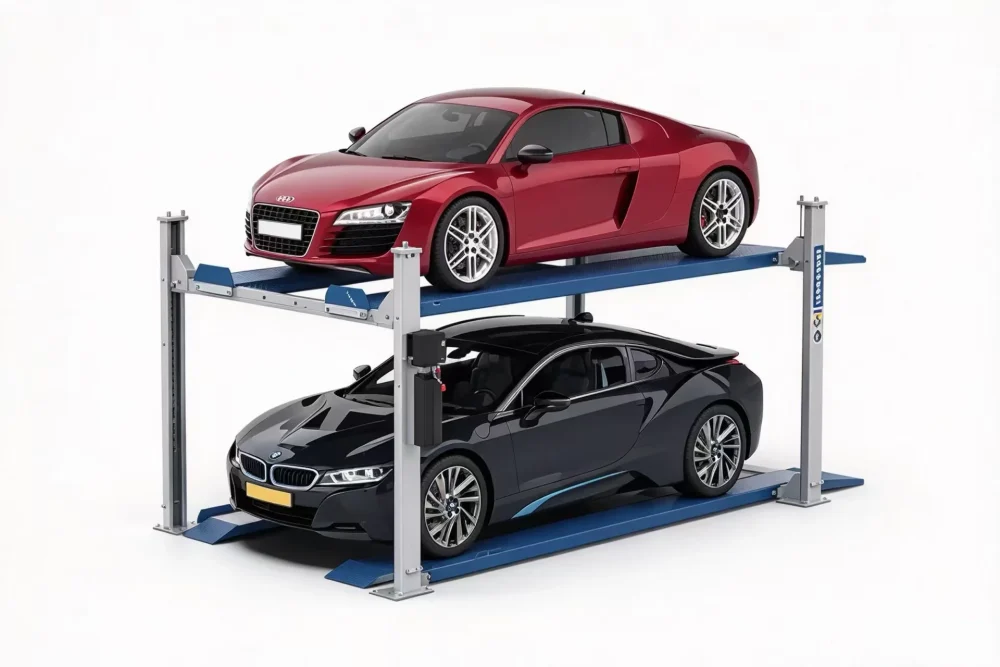
A 4 post lift serves as a portable, self-contained parking platform. You can park one vehicle on the raised runways, engage the mechanical safety locks, and park a second car underneath. Optional drip trays slide between the runways to protect the lower vehicle from fluid leaks, making a 4 post lift the ideal residential garage storage multiplier.
Safety Mechanisms and Essential Maintenance Protocols
Regardless of which model wins your 2 post vs 4 post car lift decision, both 2 post and 4 post lifts utilize heavy-duty mechanical safety locks that automatically engage at various height intervals as the lift rises. Always lower the lift onto its mechanical locks before stepping under a vehicle; never rely solely on hydraulic system pressure to hold a load overhead.
Essential Maintenance Checklist
To maintain safe operation on a 2 post vs 4 post car lift, follow these daily and monthly checks:
Inspect Equalization Cables: Verify that steel synchronization cables maintain equal tension across both columns or four corner posts.
Check Hydraulic Systems: Inspect hydraulic hoses, fittings, and cylinder seals for fluid leaks, cracking, or pressure loss.
Examine Safety Latch Engagement: Test both mechanical safety locks to confirm they engage simultaneously at every locking position.
Inspect Arm Adapters and Rubber Pads: On 2 post lifts, replace worn, cracked, or missing rubber lifting pads immediately to prevent vehicle slippage.
Lubricate Guide Columns: Apply heavy-duty grease to internal column tracks and slider blocks to minimize friction and wear.
Frequently Asked Questions (FAQ)
Q1: In a 2 post vs 4 post car lift comparison, which option is safer for home garage use?
Both designs are exceptionally safe when manufactured to ALI (Automotive Lift Institute) standards and operated correctly. A 4 post lift is often considered more forgiving for home users because driving onto runways eliminates the risk of improperly positioning lifting arms under a vehicle’s frame.
Q2: Can you do brake work or wheel service on a 4 post car lift?
Yes. Although a 4 post lift supports the vehicle by its tires, you can perform wheel and brake service by adding optional pneumatic or hydraulic rolling jack bridges. These rolling jacks sit between the runways, lifting the vehicle wheels off the tracks while on the lift.
Q3: Do I need to anchor a 4 post car lift to my concrete garage floor?
In many residential applications, anchoring a 4 post lift is optional unless required by local codes or specific heavy-duty commercial applications. Many 4 post lifts include optional caster kits, allowing you to move the unanchored lift around your shop floor when unloaded.
Q4: How thick does my garage concrete slab need to be for a 2 post vs 4 post car lift?
A 2 post lift typically requires a minimum concrete slab thickness of 4 to 6 inches rated at 3,000 PSI or higher. A 4 post lift distributes weight across four footings, often allowing installation on standard 4-inch concrete slabs.
Q5: Can I stack two SUVs using a 4 post parking car lift in a standard garage?
Stacking two full-size SUVs requires substantial vertical clearance—typically 13 to 14 feet of ceiling height—plus a high-lift garage door track conversion. Always measure the height of both vehicles and add 8 to 10 inches for runway thickness and safety lock clearance.
Conclusion & Contact Information
When deciding between a 2 post vs 4 post car lift, your final choice comes down to your primary intended use. If your priority is quick undercarriage access, suspension repair, and full wheel mobility in a commercial shop environment, a 2 post lift offers unmatched efficiency. If your focus is vehicle storage, drive-on convenience, and versatile home garage parking, a 4 post lift is the ultimate solution.
For professional equipment recommendations, floor layout consultations, or factory-direct pricing on commercial and residential automotive lifts, contact our technical team today:
Phone / WhatsApp: +86 189 5417 1380
Email: [email protected]

 Korean
 English
 Arabic
 French
 Spanish
 German
 Russian