
For home mechanics, auto repair shop owners, and commercial garage managers facing strict height limitations, finding the right vehicle lifting equipment can be a significant challenge. Standard clear-floor two-post lifts require ceiling clearances of 12 feet or more to accommodate their overhead crossbeams and safety shut-off bars. When shop ceiling heights range between 8.5 and 11 feet, installing a traditional clear-floor lift becomes practically impossible without major roof modifications. In such low-clearance environments, a floor plate car lift serves as the ultimate space-saving solution.
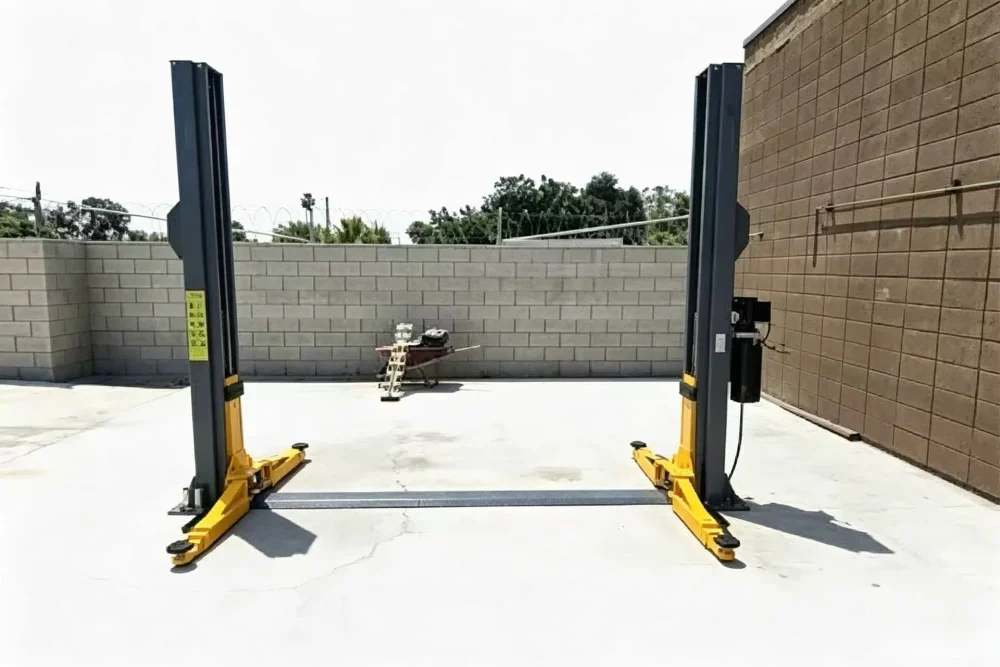
Featuring a heavy-duty hydraulic hose equalizer cover running directly across the ground between the two posts, a floor plate car lift eliminates overhead obstruction entirely. This low-clearance design allows mechanics to raise passenger cars, SUVs, and light trucks safely to workable heights without worrying about vehicle roofs making contact with upper crossbeams or building rafters.
What Makes a Floor Plate Car Lift Ideal for Low Clearances?
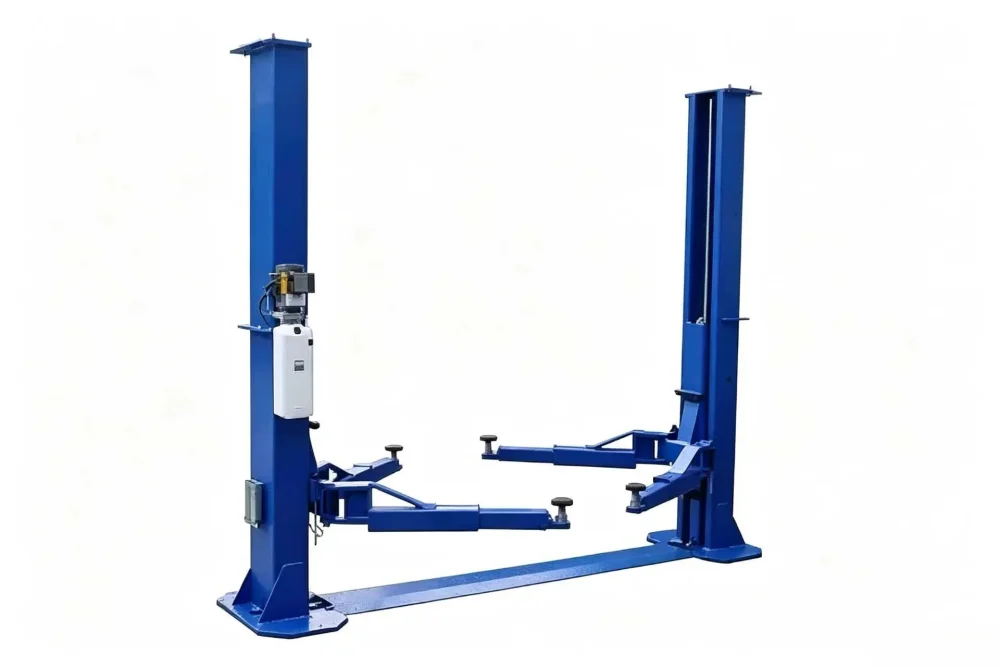
Understanding the primary structural design of a floor plate car lift helps garage owners select the right equipment for their specific space. Unlike clear-floor models that route hydraulic lines and equalizing steel cables through an elevated top arch, floor-plated models route all synchronization cables and hydraulic hoses along the ground level. A heavy-duty drive-over steel plate—typically only 1 to 1.5 inches high—covers and protects these vital mechanical components from vehicle tires and rolling shop equipment.
Key Practical Advantages for Garage Owners
Unrestricted Overhead Clearance: Because there is no top beam connecting the post tops, a floor plate car lift can be installed in garages with ceilings as low as 9 feet (2.7 meters).
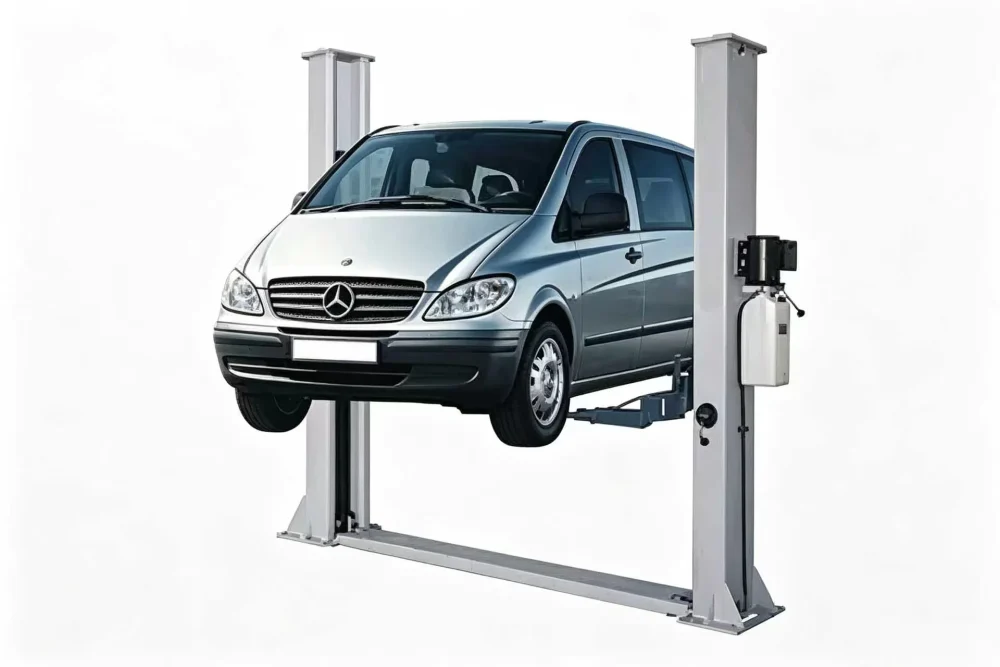
Versatile Vehicle Lifting Height: The open-overhead configuration allows technicians to service tall vans, work trucks, or boxy SUVs with roof racks that would otherwise strike an overhead shut-off bar.
Simplified Assembly and Setup: Installing this type of equipment requires fewer vertical clearances during setup, making it an ideal choice for home DIY enthusiasts working without high-reach cranes.
Heavy-Duty Load Capacity: Standard models comfortably handle lifting capacities ranging from 9,000 lbs to 12,000 lbs (4,000 kg to 5,500 kg), covering almost all passenger vehicles on the road today.
Reduced Initial Equipment Costs: Due to their straightforward structural steel layout, these lifts often offer a lower initial purchase price compared to complex overhead clear-floor alternatives.
Technical Comparison: Floor Plate vs. Clear Floor Car Lifts
When choosing two-post automotive lifting equipment, comparing floor-plated and clear-floor configurations ensures you invest in the right machine for your daily shop workflow. The following engineering comparison breaks down the key operational differences:
| Equipment Feature / Parameter | Floor Plate Car Lift | Clear Floor Car Lift |
| Overhead Beam Presence | Open top (No overhead beam) | Rigid top crossbeam with shut-off bar |
| Minimum Ceiling Height Required | 8.5 ft – 10 ft (2.6m – 3.0m) | 12 ft – 14 ft (3.6m – 4.2m) |
| Hose & Cable Routing | Across floor under low steel plate | Across overhead beam arch |
| Floor Surface Impact | Minor 1.2-inch drive-over threshold hump | 100% smooth, flat floor surface |
| Ideal Vehicle Applications | Tall vans, roof-rack SUVs, pickup trucks | Standard sedans, low sports cars |
| Installation Complexity | Moderate (Easier in low spaces) | Higher (Requires high vertical clearance) |
| Top Safety Bar Limit | No overhead vehicle height limit | Vehicle height limited by top bar |
Reviewing this table confirms that a floor plate car lift provides maximum vertical flexibility whenever overhead ceiling height is restricted.
Core Safety Systems and Heavy-Duty Engineering
Operating heavy automotive machinery requires uncompromised structural integrity. A high-performance floor plate car lift incorporates multiple redundant mechanical and hydraulic safety systems to protect technicians working beneath elevated payloads:
Dual Hydraulic Direct-Drive Cylinders
Direct-drive or chain-over-hydraulic cylinders located in each post ensure smooth, balanced lifting performance. Equipping a 2-post system with dual synchronized hydraulic cylinders reduces strain on internal seals and prolongs the operational lifespan of the main hydraulic pump unit.
Multi-Position Mechanical Safety Locks
Heavy-duty steel safety latches automatically engage as the lifting carriages ascend. Technicians working under a floor plate car lift can lower the carriage securely onto mechanical locks at multiple working heights before beginning undersurface suspension or oil pan repairs.
Low-Profile Adjustable Swing Arms
Dual-stage or triple-stage telescoping arms equipped with drop-in rubber staging pads allow the lift to easily reach factory frame jack points on low-slung sports cars as well as lifted 4×4 off-road trucks.
Dual Equalization Cable System
Aircraft-grade steel equalization cables route beneath the protective floor cover to keep both lifting arms perfectly level during ascent and descent, preventing dangerous vehicle tilting if load weight is distributed unevenly.
Site Preparation and Concrete Foundation Requirements
Proper site preparation is vital prior to purchasing and mounting a floor plate car lift in any residential or commercial service bay. Skipping foundation verification can lead to anchor failure or frame instability.
Concrete Slab Thickness: Verify that your garage floor consists of solid, unreinforced concrete at least 4 inches (100 mm) thick with a minimum compressive strength rating of 3,000 PSI.
Anchor Bolt Depth and Spacing: Anchor bolts for a floor plate car lift must penetrate a minimum of 3.5 to 4 inches into solid concrete, keeping a safe distance from expansion joints or existing floor stress cracks.
Electrical Infrastructure: Most two-post hydraulic lifts require a dedicated 220V/240V single-phase circuit (or 380V three-phase for heavy commercial shops) connected to a 20-amp or 30-amp circuit breaker.
Drive-Over Clearance Planning: Ensure that the low floor plate threshold height will not interfere with ultra-low clearance race cars or custom vehicles when driving into the bay.
Installation Tip: When anchoring the vertical columns, always use a precision spirit level to ensure both posts are perfectly plumb using steel shims before torquing floor anchor bolts to manufacturer specifications.
How a Low-Ceiling Lift Maximizes Garage Usability and ROI
Investing in the right garage equipment should yield immediate productivity improvements while maximizing available square footage. Choosing a floor plate car lift impacts your shop’s bottom line in several distinct ways:
Turn Unused Low-Ceiling Bays Into Profit Centers
Many commercial repair facilities have back rooms or side bays with lower ceilings that are typically relegated to tire storage or manual detailing. Installing a floor plate car lift transforms these underutilized areas into fully functional service bays for brake jobs, oil changes, and tire rotations.
Ideal Solution for Residential Home Shops
For home car collectors and DIY restorers working in standard suburban two-car garages, high ceiling retrofits can cost thousands of dollars. A compact floor plate car lift installs directly onto standard home concrete floors, turning residential garages into professional-grade workspaces without architectural modifications.
Versatile Handling of High-Profile Vehicles
Commercial fleets frequently service tall vans, ladder-rack trucks, and commercial utility vehicles. Because there is no top beam to restrict clearance, this configuration allows these taller vehicles to be raised as high as the building ceiling permits.
Step-by-Step Buying Checklist for Garage Buyers
To ensure you select equipment tailored precisely to your specific garage layout and vehicle types, follow this procurement checklist:
Measure Clear Ceiling Height: Measure from the floor to the lowest hanging overhead obstruction, such as garage door tracks, light fixtures, or ceiling joists.
Verify Maximum Vehicle Weight: Identify the gross vehicle weight rating (GVWR) of the heaviest vehicle you plan to lift, ensuring your chosen floor plate car lift capacity comfortably exceeds that weight.
Determine Drive-Thru Width: Measure the width of your widest vehicles (including side mirrors) to confirm easy positioning between the lift columns.
Check Concrete Quality: Perform a concrete test drill or core sample to confirm floor thickness and structural integrity prior to equipment delivery.
Select Suitable Arm Configurations: Choose between symmetric swing arms (equal length front and rear) or asymmetric arms (shorter front arms) based on whether you prefer centered or rear-offset vehicle positioning.
Preventive Maintenance Rules for Long-Term Reliability
Establishing a routine maintenance schedule keeps your floor plate car lift operating smoothly, safely, and efficiently for years to come.
Weekly Cable and Floor Plate Inspection: Periodically lift the steel floor cover on your floor plate car lift to sweep out accumulated dirt, road salt, or moisture, and check steel equalizer cables for fraying or tension loss.
Monthly Lubrication Routine: Apply heavy-duty lithium grease to post slide tracks, pulley sheaves, arm restraint gears, and arm hinge pins.
Hydraulic System Fluid Check: Inspect fluid levels in the power unit reservoir monthly. Replace hydraulic oil annually to prevent valve contamination and internal seal wear.
Anchor Bolt Torque Check: Check column floor anchor bolts with a torque wrench every six months to ensure they remain tightly secured to the concrete slab.
Frequently Asked Questions (FAQ)
Q: Can I install a floor plate car lift in a standard home garage?
A: Absolutely! The primary advantage of a floor plate car lift is its ability to fit inside residential garages with standard 8.5-foot, 9-foot, or 10-foot ceiling heights where clear-floor lifts cannot fit.
Q: Does the floor plate cover get in the way of transmission jacks or tool carts?
A: The protective floor plate cover is bevelled and sits only about 1 to 1.5 inches off the ground. While heavy tool carts and transmission jacks can roll over it easily, caution should be taken when moving equipment with ultra-small caster wheels across the threshold.
Q: What is the typical weight capacity of a 2-post floor plate car lift?
A: Standard residential and light commercial models usually offer capacities of 9,000 lbs, 10,000 lbs, or 12,000 lbs, which easily accommodates passenger sedans, crossovers, SUVs, and full-size half-ton pickup trucks.
Q: Is a floor plate car lift harder to maintain than an overhead clear-floor model?
A: Not at all. Maintenance for a floor plate car lift is practically identical, with the only additional step being occasionally removing the floor plate cover to inspect and clean the lower cable routing channel.
Q: Can I use this type of lift for long-term vehicle parking storage?
A: Yes, once the lift carriages are lowered securely onto their mechanical safety locks, a floor plate car lift can hold a vehicle safely in an elevated position for long-term storage, freeing up ground floor space beneath.
Upgrade Your Garage Capabilities Today
Adding a high-quality floor plate car lift to your garage eliminates low-ceiling restrictions while providing safe, full-underbody vehicle access for all repair, maintenance, and restoration projects.
Looking for direct factory pricing, custom lifting capacities, or technical specifications for your automotive garage project? Contact our lifting equipment specialists today:
Email: [email protected]
Phone / WhatsApp: +86 189 5417 1380
 Korean
 English
 Arabic
 French
 Spanish
 German
 Russian