
For modern automotive repair shops, commercial garages, and residential car enthusiasts, maximizing workshop floor space is a continuous challenge. Traditional two-post and four-post lifts have long been the industry standard, but their large structural footprints can make smaller service bays feel cramped and restrict natural workflow.
This spatial bottleneck is exactly why the car scissors lift has surged in popularity across the global automotive service sector. By utilizing a collapsible, crisscross geometric framework that retracts flat into the ground or sits low on the floor surface, this specialized lifting system provides an unparalleled balance of heavy-duty power, spatial efficiency, and under-car accessibility.
Whether you manage a high-volume commercial tire center, a body shop requiring clear side access, or a home garage with limited overhead clearance, choosing the right lifting equipment is paramount. In this comprehensive guide, we will explore the engineering mechanics behind the car scissors lift, analyze the distinct types available on the market, look at core safety protocols, and help you select the ideal model for your operations.
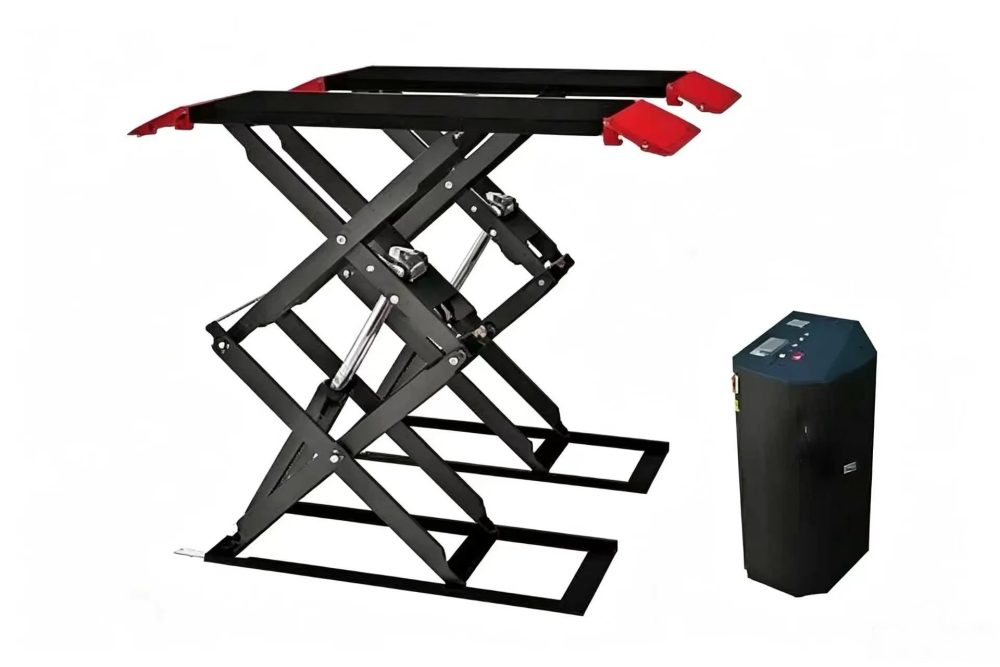
The Core Advantages of a Car Scissors Lift
When compared to conventional vertical pillars, a car scissors lift offers a unique set of structural benefits that directly translate into improved mechanics’ efficiency and increased daily throughput.
1. Superior Space Optimization
The most noticeable benefit of installing a car scissors lift is the immediate reclamation of shop floor space. Because the lifting mechanisms operate entirely beneath the vehicle chassis, there are no outer columns or overhead crossbars to navigate. When fully lowered, flush-mount models blend seamlessly into the concrete floor, allowing vehicles to drive completely over them and enabling the bay to be utilized for other non-lifting maintenance tasks.
2. Enhanced Exterior Ergonomics
For tasks like wheel balancing, brake servicing, body panel repair, and detailing, side obstructions are incredibly frustrating. A two-post system blocks the vehicle doors, forcing technicians to squeeze past columns. A high-quality car scissors lift eliminates this barrier entirely, leaving the entire perimeter of the automobile completely unobstructed for seamless tool movement and detailing work.
3. Lower Ceiling Clearance Compatibility
Four-post lifts require immense overhead vertical space to fully function. Many residential garages or older commercial buildings feature low ceilings that cannot accommodate massive vertical pillars. A low-profile or mid-rise car scissors lift solves this issue by offering tailored lifting heights that safely maximize whatever vertical clearance your ceiling allows.
Types of Car Scissors Lifts Defined
Not all lifting systems are built the same way. Depending on your primary service tasks—whether it’s fast tire changes or comprehensive transmission overhauls—you will need to choose from three primary structural configurations.
1. Low-Profile / Mid-Rise Mobile Lifts
These portable systems are highly favored by detailing shops, tire service centers, and home DIYers. They typically offer a maximum lifting height of 26 to 48 inches (660 \ to1200 mm).
Mobility: Many models feature integrated wheel kits, allowing a single operator to roll the car scissors lift out of the way when it is not in use.
Best For: Wheel and brake work, body repairs, wrapping, and detailing.
2. Full-Rise Independent Runway Lifts
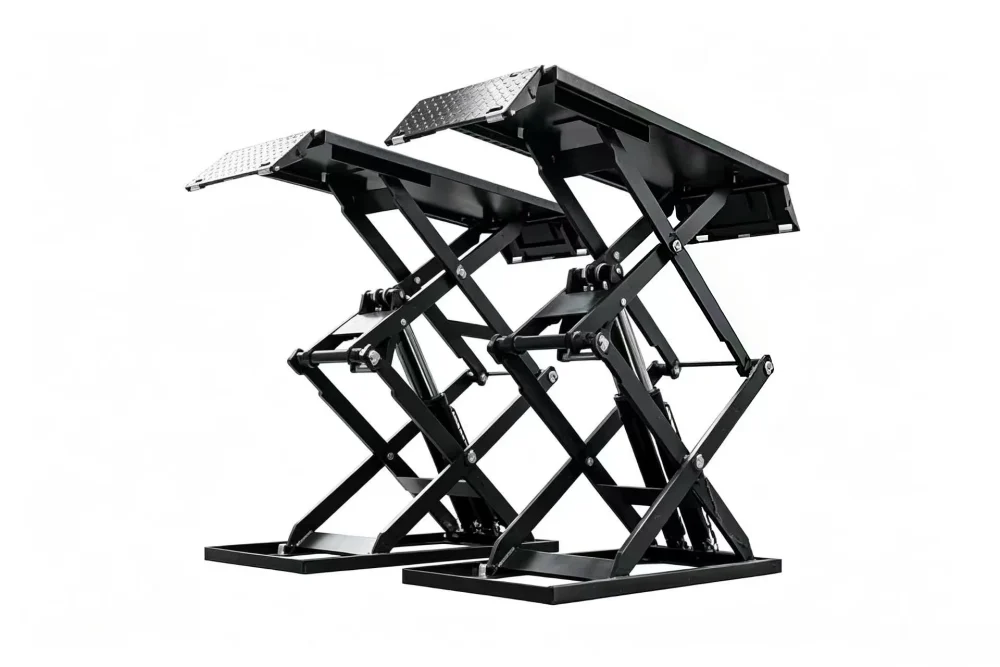
Engineered for deep mechanical repairs, full-rise systems lift vehicles up to 70 inches (1780 mm) or higher, allowing a full-grown technician to stand comfortably underneath the vehicle chassis.
Design: They feature two separate, parallel platforms that lift the vehicle by its tires or designated frame points.
Best For: Exhaust work, transmission drops, and general under-chassis mechanical inspection.
3. Wheel Alignment Scissors Lifts
This is the heavy-duty pinnacle of the car scissors lift family. These systems feature long, reinforced runways equipped with integrated rear slip plates and front turn-table recesses explicitly designed to pair with 3D wheel alignment cameras.
Precision: They are built with advanced hydraulic synchronization systems to ensure both runways remain perfectly level down to the millimeter, which is crucial for sensitive electronic steering calibrations.
Feature Comparison Matrix
To assist your procurement team in identifying the best structural configuration, the table below synthesizes the key performance metrics, drive styles, and target environments for modern lifting configurations.
| Lift Configuration | Typical Load Capacity | Maximum Lifting Height | Installation Style | Primary Target Applications |
| Low-Profile / Mid-Rise | 6,000 – 7,500 lbs | 26 – 48 Inches | Surface Mounted (Portable) | Detailing, tire shops, residential garages |
| Full-Rise Platform | 7,000 – 9,000 lbs | 70 – 78 Inches | Flush-Mount or Surface | General mechanics, transmission repair |
| Heavy-Duty Alignment | 10,000 – 14,000 lbs | 72 – 82 Inches | Flush-Mount In-Ground | Commercial alignment bays, fleet services |
Critical Engineering & Safety Elements
Investing in a car scissors lift means trusting industrial hydraulics with both high-value vehicles and technician safety. High-quality manufacturing standards separate professional-grade tools from hazardous cheap imitations.
Hydraulic Synchronization Systems
Because a car scissors lift relies on separate hydraulic cylinders pushing individual platforms, maintaining equal fluid pressure is vital. If one platform rises faster than the other, the vehicle will tilt and risk tipping over. Premium manufacturers implement electronic master-slave hydraulic loops or mechanical torsion bars to guarantee perfectly synchronous movement during ascent and descent.
Mechanical Safety Locks
Hydraulic pressure should only be used to raise and lower the vehicle, never to hold it stationary during a repair. A dependable car scissors lift features a robust, multi-position mechanical ladder lock system that automatically drops into place as the lift rises. Once the desired height is reached, the operator lowers the lift slightly onto these physical steel locks, relieving pressure on the hydraulic lines.
Pneumatic Lock Releases
Cheap lifting units require the operator to walk around and manually trip mechanical levers to lower the platform. Professional models feature an integrated pneumatic air-lock release system. With a single button press on the main control console, air cylinders instantly disengage the safety teeth, allowing for a smooth, single-operator lowering sequence.
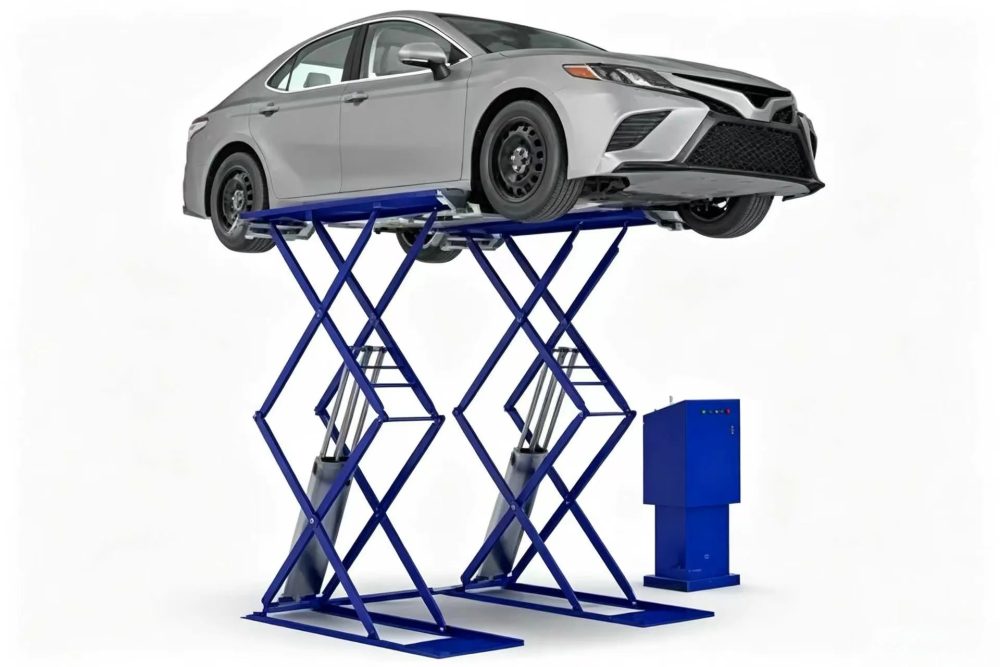
Installation Styles: Surface Mount vs. Flush Mount
When purchasing a full-rise or alignment-level car scissors lift, you must decide how the unit will sit on or within your shop floor. Both installation styles have clear trade-offs.
Surface-Mounted Installation
In a surface-mount configuration, the lift assembly is bolted directly to the top of your existing concrete slab.
Pros: Lower initial setup costs, faster installation times, and zero excavation required.
Cons: Even when fully collapsed, the runways sit roughly 4 to 7 inches above the ground. Low-clearance sports cars may require extended drive-on ramps to avoid scraping the front bumpers.
Flush-Mounted In-Ground Installation
This approach requires cutting pits into your workshop’s concrete floor so that the collapsed car scissors lift rests perfectly level with the surrounding floor surface.
Pros: Unmatched aesthetic appeal, completely flat floor workflow, and effortless drive-on capability for ultra-low racing vehicles.
Cons: Higher initial setup costs due to concrete cutting, excavation, and structural pit preparation.
Key Questions to Ask Before Purchasing
To ensure you acquire a unit that matches your daily operational realities, take time to evaluate these workflow variables before signing a purchase order:
What is the heaviest vehicle your shop services regularly? If you primarily repair compact electric vehicles and sedans, a 7,000-lb capacity unit is perfect. If you regularly handle heavy duty pickup trucks or commercial vans, look toward a 12,000-lb capacity alignment-grade system.
What are your local concrete concrete parameters? Most heavy-duty lifts require a minimum concrete thickness of 4 to 6 inches with a rating of 3,000 PSI or greater to safely anchor the structural baseplates.
Do you require under-chassis central clearance? If your primary business is changing full exhaust systems or dropping fuel tanks, ensure the center space between the two lift runways matches your technical access needs.
Preguntas frecuentes
Can a car scissors lift be used for heavy electric vehicles (EVs)?
Yes, but you must be mindful of weight distribution and overall capacity. Electric vehicles are significantly heavier than traditional internal combustion cars due to their massive under-floor battery packs. Ensure the rated capacity of your lift accommodates this increased mass, and verify that the platform pick-up points do not compress or damage vulnerable battery enclosures.
How often does the hydraulic system require maintenance?
For commercial environments, we recommend a monthly inspection of hydraulic fluid levels, checking hoses for signs of abrasion, and lubricating all pivot points. The hydraulic oil itself should be completely flushed and replaced every 1 to 2 years, depending on your daily operational cycles, to prevent dirt accumulation from damaging internal cylinder seals.
What happens if the workshop loses electrical power while a vehicle is raised?
Every certified car scissors lift is equipped with a manual emergency lowering valve located on the hydraulic power unit. If power fails, a technician can slowly open this valve to manually bleed pressure out of the cylinders, allowing the lift to safely descend from its mechanical locks down to the shop floor.
Are portable scissor lifts safe for commercial garage use?
Portable mid-rise models are incredibly safe provided they are used on flat, level, solid concrete surfaces and are never loaded beyond their stamped capacity limits. However, for high-volume commercial shops performing comprehensive underside mechanical overhauls daily, a permanently anchored full-rise system is generally preferred for optimal structural rigidity.
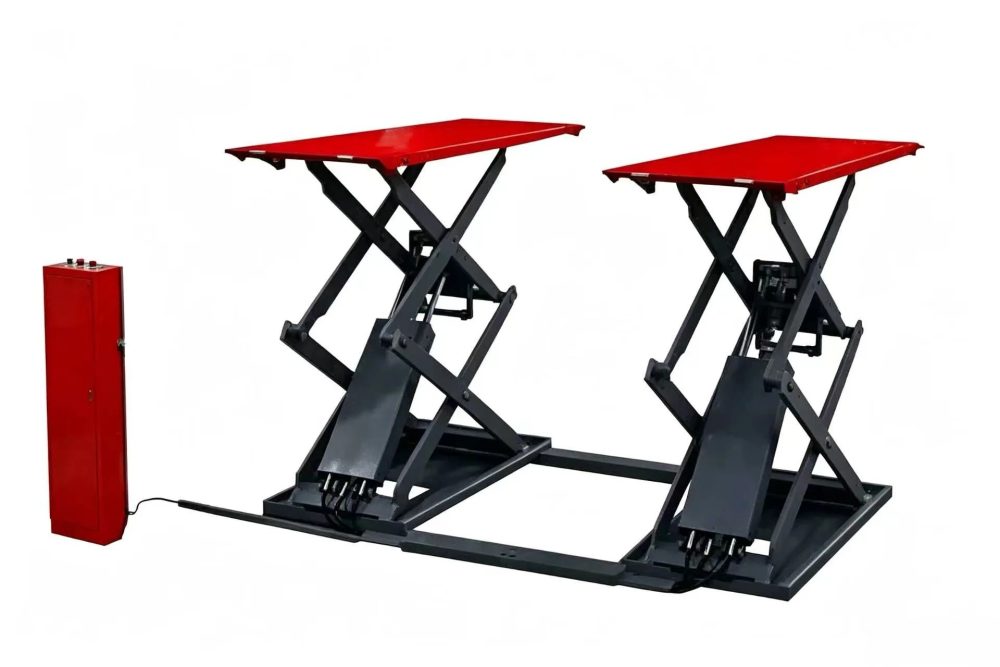
Partner With Leading Automotive Lift Engineers
Equipping your service bays with reliable, space-saving lifting machinery is the fastest way to reduce bay congestion, improve technician ergonomics, and maximize your business’s revenue potential.
If you are looking to source a highly durable, precision-engineered car scissors lift for your commercial workshop, logistics center, or specialized garage, our technical support team is standing by to provide exact specifications, structural pit layout dimensions, and custom manufacturing quotes.
Get in touch with us today to take your workspace efficiency to the next level:
Phone: +86 18954171380
Email: [email protected]
 Spanish
 English
 Arabic
 French
 Korean
 German
 Russian