
Urbanization and increasing vehicle ownership continue to strain limited parking spaces in modern cities, private residential garages, commercial complexes, and automotive dealerships. As floor space becomes more scarce and expensive, traditional horizontal parking expansions are often financially or physically impractical. To overcome these space constraints, property owners and real estate developers are increasingly turning to vertical space utilization. Among the various spatial optimization solutions available today, installing a double stacker parking lift has emerged as one of the most efficient, safe, and cost-effective methods to instantly double existing parking capacity on a single footprint.
By utilizing vertical height that usually goes wasted in private garages or commercial lots, a double stacker parking lift allows two vehicles to be parked securely in a single conventional parking bay. Understanding the mechanics, safety innovations, structural prerequisites, and practical benefits of this equipment will help homeowners, facility managers, and developers make informed decisions for their properties.
Understanding the Mechanics of Double Stacker Systems
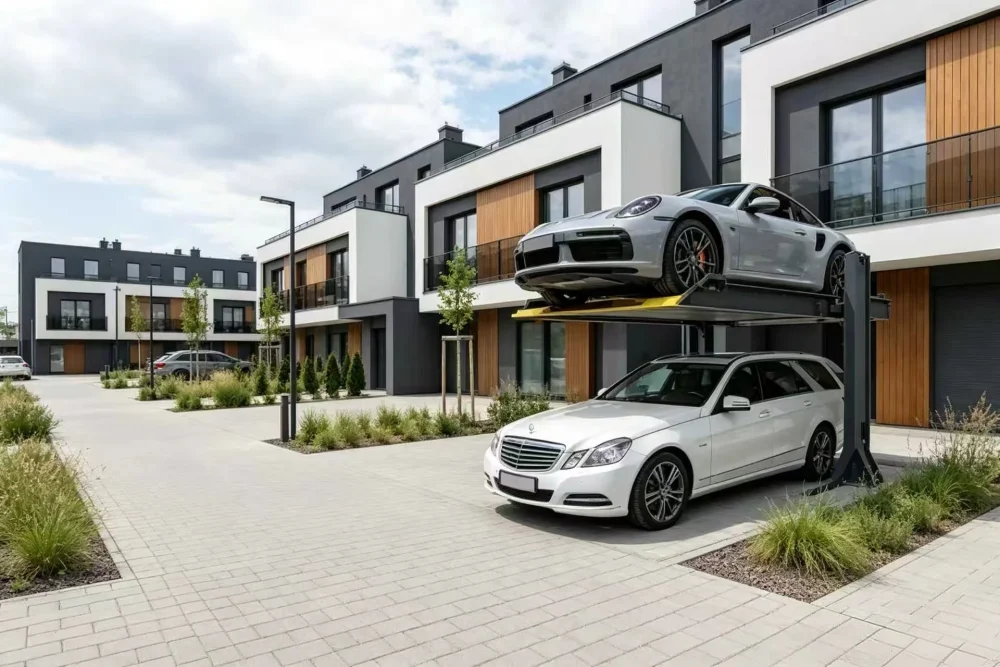
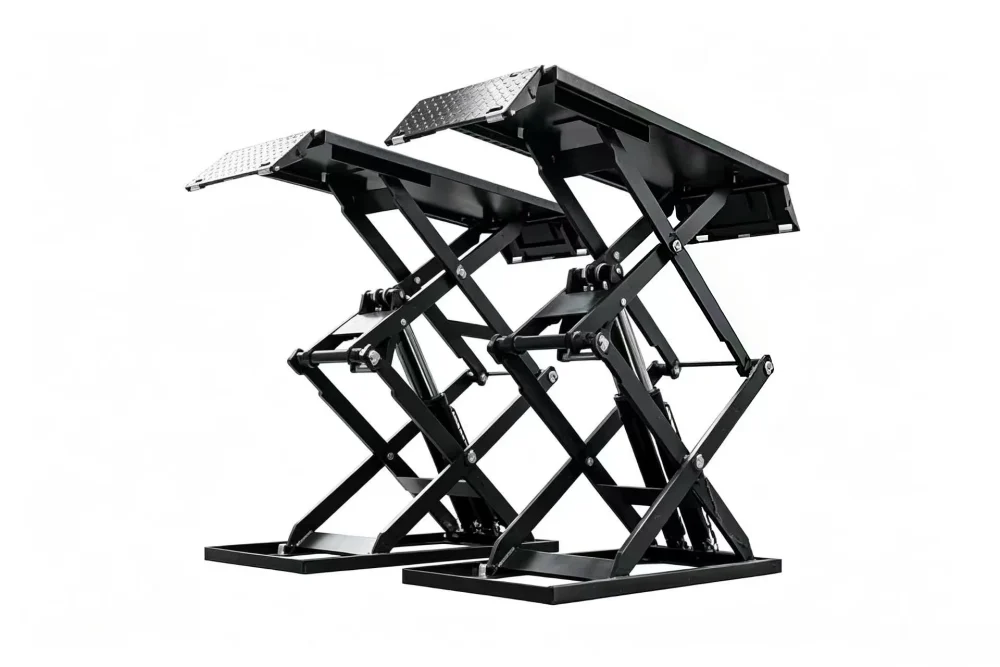
The fundamental operating principle behind a double stacker parking lift is straightforward yet highly refined: elevating one vehicle on a heavy-duty platform to create clear ground-level space beneath it for a second vehicle.
These mechanical platforms are primarily powered by electro-hydraulic power units or mechanical traction drive systems. Hydraulic systems utilize heavy-duty hydraulic cylinders paired with high-tensile steel equalization cables or chains to ensure that the platform remains perfectly level during upward and downward travel. Guided by robust structural steel posts, the platform lifts the upper vehicle smoothly, locking it safely at a designated working height. Once the platform is elevated and secured by mechanical locks, a second sedan, SUV, or sports car can be parked directly underneath.
Key Structural Components
Load-Bearing Steel Columns: Fabricated from high-grade structural steel, these upright posts anchor to the floor foundation to absorb lateral forces and vertical weight distribution.
Elevating Drive Platform: A corrugated steel or aluminum deck designed to hold the upper vehicle securely while preventing fluid drips, grease, or dirt from falling onto the car parked below.
Electro-Hydraulic Power Unit: Consisting of a quiet electric motor, hydraulic fluid reservoir, and high-pressure pump that delivers hydraulic power to the lifting cylinders.
Equalization and Cable Guide Assembly: Steel wire ropes or leaf chains that maintain sync across both lifting sides, preventing platform tilting during uneven weight loading.
Primary Benefits of Installing a Double Stacker Parking Lift
1. Instant Doubling of Parking Capacity
The most obvious advantage of deploying a double stacker parking lift is the immediate doubling of parking density. Rather than undergoing expensive property acquisitions or invasive building expansions, property owners can maximize vertical headroom that is already available inside a residential garage or commercial parking structure.
2. Vehicle Protection and Storage Security
Beyond space creation, a double stacker parking lift serves as an effective security solution for valuable automobiles. Classic cars, luxury vehicles, or seasonal sports cars elevated on the upper platform are kept safe from accidental scratches, door dings, theft, and unauthorized access, keeping them off the busy lower floor area.
3. Lower Cost per Parking Space
Compared to the significant civil engineering expenses associated with digging subterranean multi-level parking basements or building multi-story concrete structures, installing a surface-mounted double stacker parking lift requires substantially lower capital expenditure per newly created parking spot.
4. Versatility Across Residential and Commercial Applications
Modern lifting equipment is engineered to fit a wide array of environments. Whether utilized in a residential garage with low ceiling clearance, a commercial valet parking facility, an auto repair shop, or a car dealership showroom, these versatile systems adapt easily to diverse structural layouts.
Technical Specifications and Model Comparison
Selecting the ideal vehicle stacker configuration depends heavily on target vehicle weights, garage dimensions, and site access. Below is a comparative technical breakdown of common mechanical parking lift configurations.
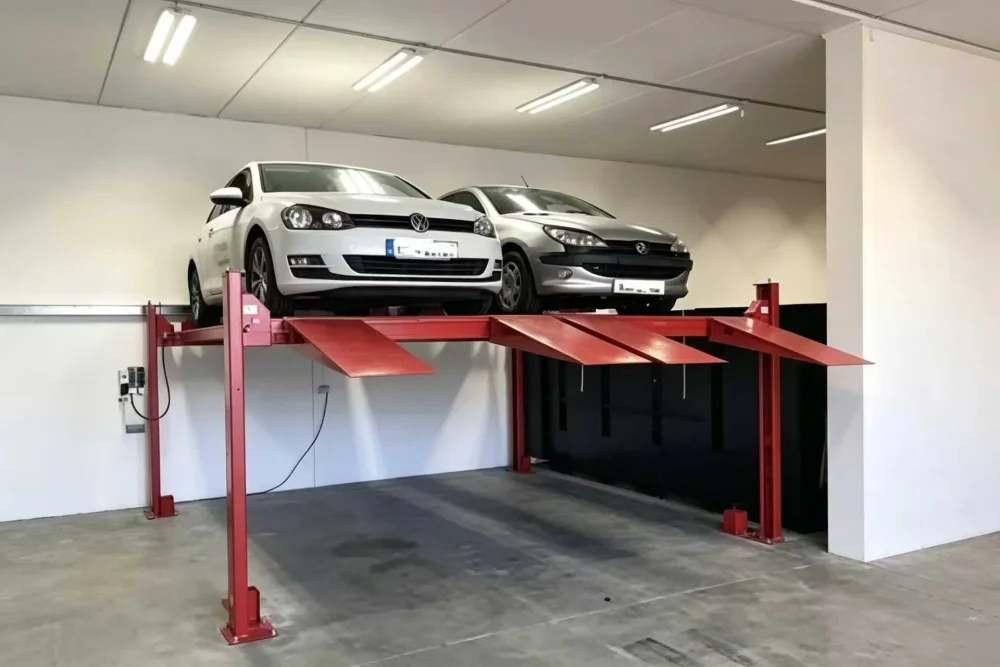
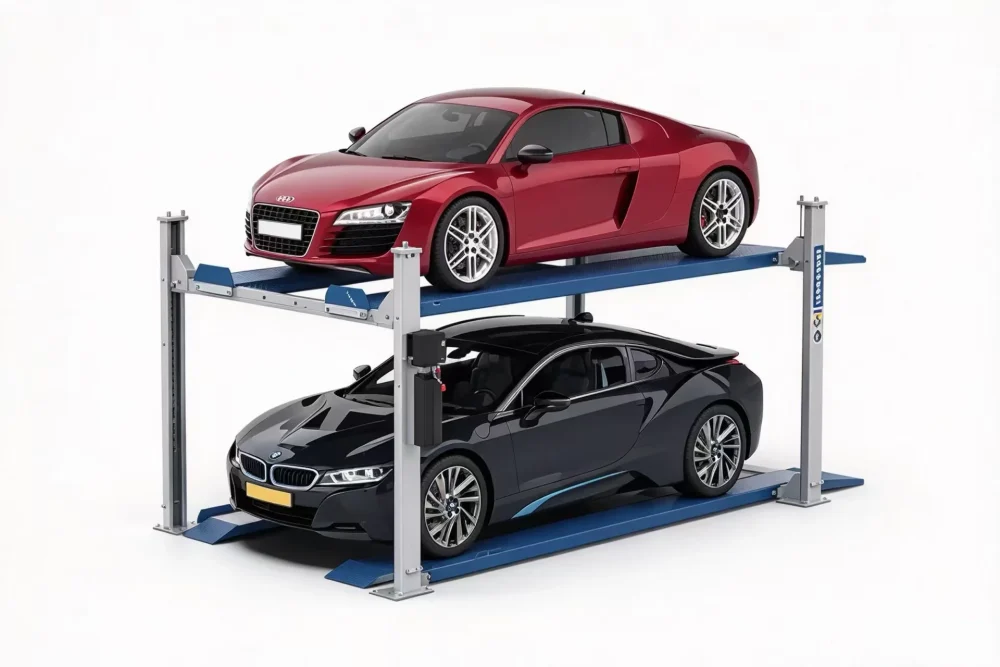
| Lift Specification | Two-Post Double Stacker | Four-Post Parking Lift | Subterranean Pit Stacker |
| Typical Lifting Capacity | 2,000 kg – 3,200 kg | 3,000 kg – 4,500 kg | 2,500 kg – 3,500 kg |
| Footprint Requirement | Compact / Minimal Width | Wider / Four Corner Posts | Medium (Requires Concrete Pit) |
| Ceiling Clearance Need | High (3.0 m – 3.8 m) | High (3.2 m – 4.0 m) | Moderate (Uses Lower Pit) |
| Installation Complexity | Low to Moderate (1–2 Days) | Moderate (2–3 Days) | High (Civil Excavation) |
| Independent Vehicle Access | Dependent (Bottom Car First) | Dependent (Bottom Car First) | Fully Independent Access |
| Ideal Application Setup | Residential Garages & Valet | Heavy Vehicles & Storage | Multi-Unit Residential & Public |
Essential Site Requirements and Installation Prerequisites
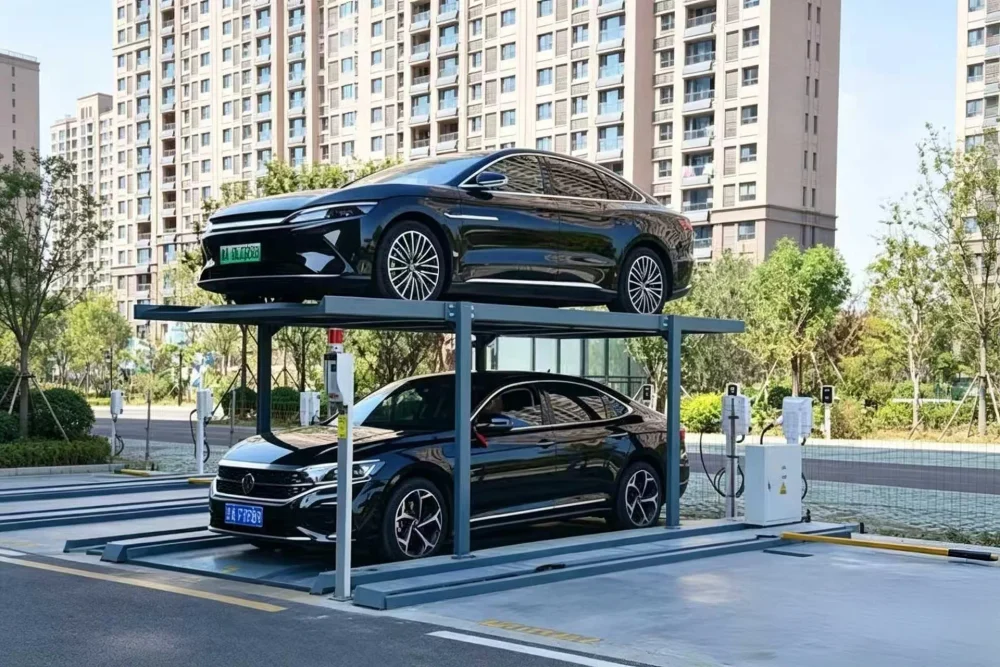
Before purchasing or installing a double stacker parking lift, general contractors, property managers, and homeowners must evaluate several vital site conditions to ensure smooth installation and long-term operational safety:
Vertical Ceiling Clearance: Clear vertical height is critical. To park two standard sedans vertically, a minimum garage height of approximately 3.0 to 3.2 meters is required. Accommodating larger SUVs or light trucks on either level may require 3.6 meters or more of vertical clearance.
Concrete Foundation Requirements: The installation floor must consist of level, solid concrete with a minimum thickness (typically 150 mm to 200 mm) and appropriate PSI rating to securely anchor post expansion bolts against lateral leverage.
Electrical Infrastructure: Verify whether your facility supports standard single-phase 220V power or requires three-phase power connections for faster lifting speed and heavy commercial duty cycles.
Door Overhead and Garage Track Alignment: Standard garage roll-up doors and ceiling-mounted openers can interfere with elevated platform clearance. Retrofitting to high-lift garage door tracks or wall-mounted openers is often recommended.
Advanced Safety Features in Modern Mechanical Lifts
Passenger safety, operator security, and vehicle protection are essential considerations in mechanical parking lift design. A modern double stacker parking lift incorporates multi-layered mechanical, electrical, and hydraulic safeguards to protect users and vehicles:
Automatic Anti-Fall Mechanical Locks: Multi-position mechanical safety latches are positioned inside vertical columns. As the platform rises, spring-loaded steel locks continuously engage, holding the platform securely in place even if hydraulic pressure is lost completely.
Emergency Stop Control Circuit: A highly visible, red mushroom emergency stop button on the control panel allows operators to immediately cut circuit power and pause all platform movements in critical situations.
Hydraulic Pressure Relief Valves: Built-in overload prevention valves stop the lifting pump if a vehicle exceeds the platform’s certified payload limit, preventing structural strain.
Limit Switches and Height Cut-Offs: Upper limit switches automatically shut off the motor when the platform reaches its maximum safe clearance height, preventing vehicles from contacting garage ceilings.
Photoelectric Safety Sensors: Optical beam sensors across the lower parking bay detect if a vehicle or person is present underneath, preventing the upper platform from descending when the lower bay is occupied.
Operational Scenarios and Real-World Applications
The flexibility of a double stacker parking lift makes it an effective solution across numerous residential and commercial settings:
1. Suburban Residential Garages
Homeowners with multiple vehicles often face tight parking restrictions or limited driveway space. Installing a compact single-unit stacker transforms a single-bay garage into a two-vehicle storage vault, keeping cars sheltered from harsh weather and vandalism.
2. Commercial Valet Lots and Urban Facilities
Valet operations in high-density urban downtowns rely on mechanical lifts to maximize paid vehicle capacity within limited surface lots, multiplying hourly revenue per square meter without requiring structural additions.
3. Automotive Dealerships and Service Centers
Dealerships and auto repair centers frequently struggle with inventory storage and service vehicle staging. Elevating vehicles vertically keeps inventory safe, clean, and organized while keeping ground-level floor space open for detailing and mechanical repairs.
4. Residential Apartment Complexes and Condos
Real estate developers building multi-family residential housing can satisfy local municipal parking ratio requirements by integrating mechanical stackers, reducing costly underground concrete excavation while offering residents private, dedicated parking spaces.
Recommended Maintenance Protocols for Long-Term Reliability
Systematic preventative maintenance keeps a double stacker parking lift operating quietly, smoothly, and safely for decades:
Monthly Visual Inspections: Inspect steel lifting cables or chains for fraying or tension imbalance, verify that limit switches function properly, and check for hydraulic hose leaks.
Quarterly Mechanical Lubrication: Apply grease to vertical guide rail surfaces, pulley sheaves, and mechanical locking latch pivot points to minimize friction and wear.
Semi-Annual Electrical and Hydraulic Checks: Inspect control panel wire connections, test emergency stop response, and verify hydraulic fluid clarity, topping off oil reservoirs as needed.
Annual Certified Load Inspections: Have certified service technicians conduct comprehensive load testing, verify anchor bolt torque settings, and audit mechanical safety lock engagement.
Frequently Asked Questions (FAQ)
Q1: Can a double stacker parking lift accommodate large SUVs or trucks?
Yes, high-capacity models with payload limits of 3,000 kg to 3,500 kg and extended platform clearance are specifically engineered to accommodate heavy SUVs, crossovers, and light trucks. Always verify vehicle weight and height dimensions before selecting a lift model.
Q2: How long does it take to raise or lower the platform?
Most electro-hydraulic systems take approximately 30 to 50 seconds to complete a full lifting or lowering cycle. This rapid operation ensures convenient access for daily drivers without causing long delays.
Q3: What happens if there is a main power outage while a car is raised?
Quality mechanical parking lifts feature a manual lowering release valve on the hydraulic pump unit. In the event of a power outage, an authorized user can manually release the hydraulic pressure to lower the platform safely back to ground level.
Q4: Can a double stacker parking lift be installed outdoors?
Yes, outdoor models are available with specialized weatherproofing finishes, such as hot-dip galvanizing, waterproof IP65 electrical control enclosures, and sealed motor housings engineered to resist rain, snow, and rust.
Conclusion and Contact Information
For homeowners, commercial parking managers, and real estate developers seeking a dependable way to resolve spatial bottlenecks, a double stacker parking lift delivers a proven, space-saving solution. By capitalizing on vertical height, these durable platforms double existing parking real estate, protect valuable automotive investments, and reduce long-term facility costs.
For customized spatial planning, site evaluation assistance, or factory-direct quotes on a high-grade double stacker parking lift, contact our engineering team today:
Phone / WhatsApp: +86 189 5417 1380
Электронная почта: [email protected]
 Russian
 English
 Arabic
 French
 Korean
 Spanish
 German